 Loading...
| Jan 01, 1970 | Daily Report |
| RISING BHARAT | News Count (102144) | |
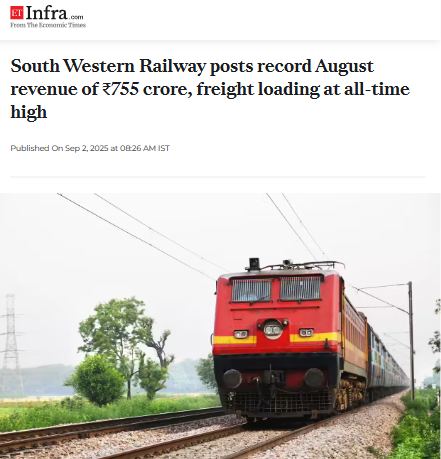
1191. South Western Railway posts record August revenue of ₹755 crore, freight loading at all-time high
- On 2 September, 2025 It was Reported that, In August 2025, South Western Railway (SWR) achieved its best-ever August performance by recording gross revenue of ₹755 crore, with freight loading of 4.2 MT and passenger earnings of ₹305 crore across its operating region.
- The remarkable growth was driven by record freight earnings of ₹418 crore, supported by significant increases in loading of iron ore, steel, coal, RMSP, fertiliser, containers, and foodgrains, along with higher passenger numbers, reflecting better connectivity and operational efficiency.
- The performance underscores SWR’s balanced growth across passenger and freight sectors. Additional revenues came from parcel traffic, coaching, sundry earnings, and penalties. The results highlight enhanced financial security, customer confidence, and effective commercial initiatives by SWR’s dedicated workforce.
Click here to find 1469 similar incidents of Bharat Economic Growth -> Bharat Economic Growth

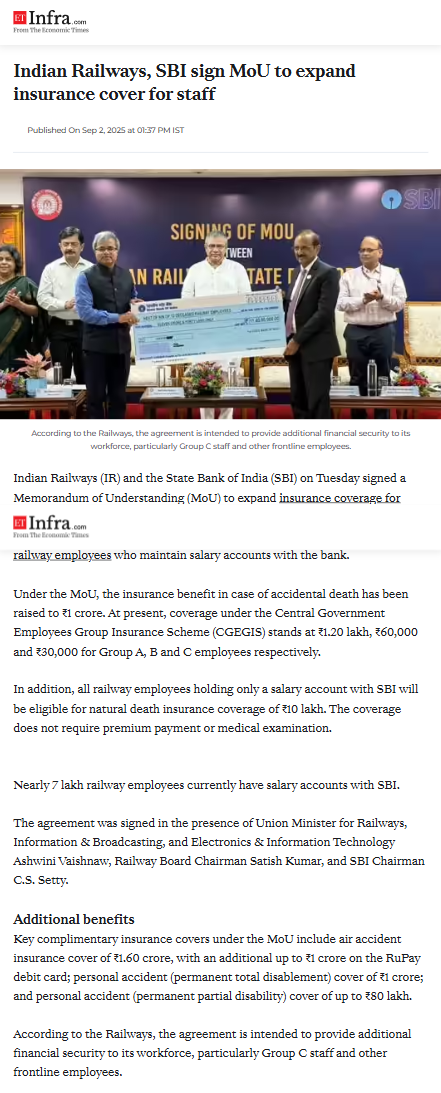
1192. Indian Railways, SBI sign MoU to expand insurance cover for staff
- On September 2, 2025, Indian Railways (IR) and the State Bank of India (SBI) signed an MoU in New Delhi to enhance insurance coverage for railway employees holding salary accounts with SBI, increasing accidental death cover to ₹1 crore.
- The MoU aims to provide greater financial security for railway employees, especially Group C and frontline staff. Coverage is automatic, requiring no premium or medical tests, ensuring both accidental and natural death risks are addressed more effectively than existing CGEGIS provisions.
- Nearly 7 lakh railway employees with SBI accounts benefit. Additional covers include ₹1.60 crore air accident insurance, ₹1 crore permanent disability cover, and ₹80 lakh partial disability cover, plus RuPay card-linked benefits, significantly expanding protection compared to earlier limited CGEGIS coverage.
1193. 117 crore to make four NHAI stretches in Tamil Nadu 'zero fatality highways'
- On September 2, 2025, it was reported that the National Highways Authority of India (NHAI) sanctioned ₹117 crore to upgrade four accident-prone stretches in Tamil Nadu, including the Madurai–Kayathar section of NH-44 and Chennai–Tada corridor of NH-16.
- The funding targets blackspots and frequent accident zones by constructing underpasses, widening roads, improving junctions, and adding rumble strips, crash barriers, reflective boards, and lighting. These rectifications aim to reduce fatalities, enhance traffic flow, and strengthen road safety across key stretches.
- Tamil Nadu reported 20,582 national highway accidents in 2023, the highest in India, with 6,258 deaths. By addressing design flaws, poor infrastructure, and unsafe vehicle practices, NHAI’s ‘zero fatality highways’ initiative marks a critical push toward reducing accidents and improving highway discipline.
Click here to find 427 similar incidents of Make in India / Atmanirbhar -> Roads and Highways
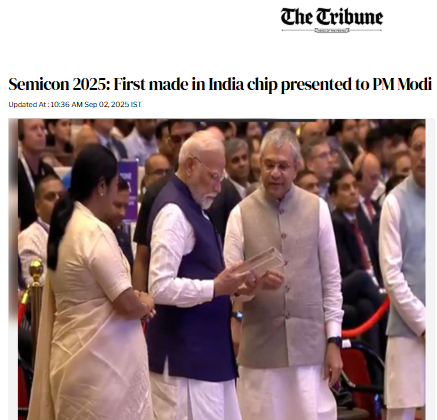
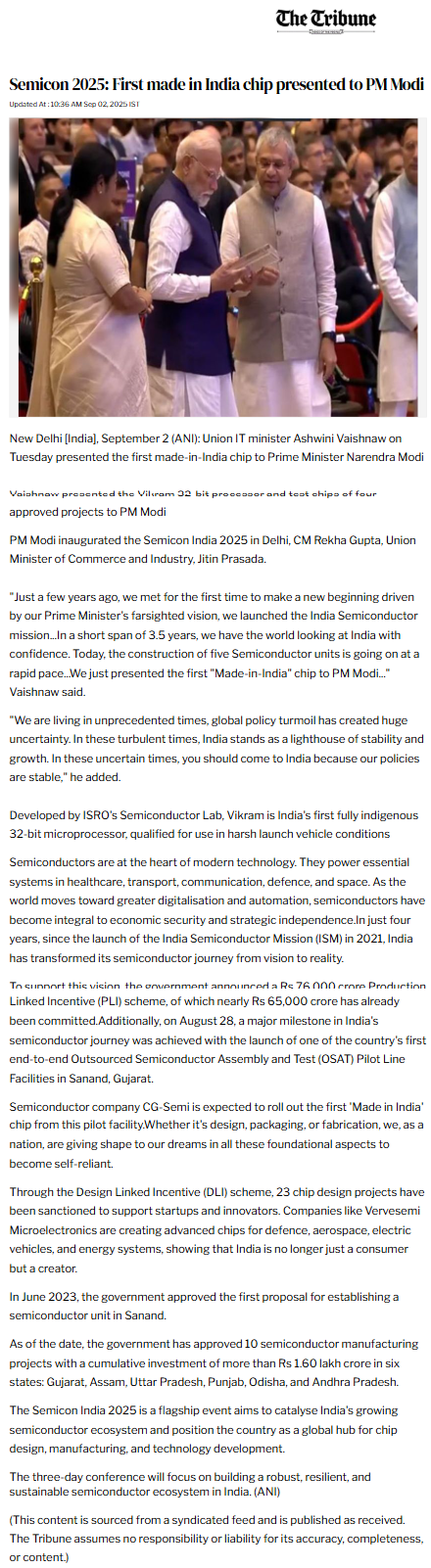
1194. Semicon 2025: First made in India chip presented to PM Modi
- On September 2, 2025, at the Semicon India 2025 in Delhi, Union IT Minister presented India’s first indigenous chip, the Vikram 32-bit processor, developed by ISRO’s Semiconductor Lab, to Prime Minister of India.
- India’s semiconductor mission, launched in 2021, has rapidly advanced with a ₹76,000 crore PLI scheme and 23 sanctioned design projects, creating chips for defence, aerospace, and EVs. Five semiconductor units are under construction, showing India’s leap from consumer to creator.
- The Vikram processor, designed for harsh launch vehicle conditions, marks a milestone in self-reliance. With ₹1.60 lakh crore approved investments across six states, India aims to become a global hub for chip design, manufacturing, and sustainable semiconductor technology through Semicon India 2025.
Click here to find 274 similar incidents of Make in India / Atmanirbhar -> Electronic Systems
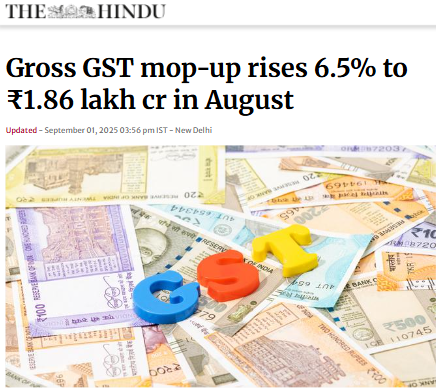
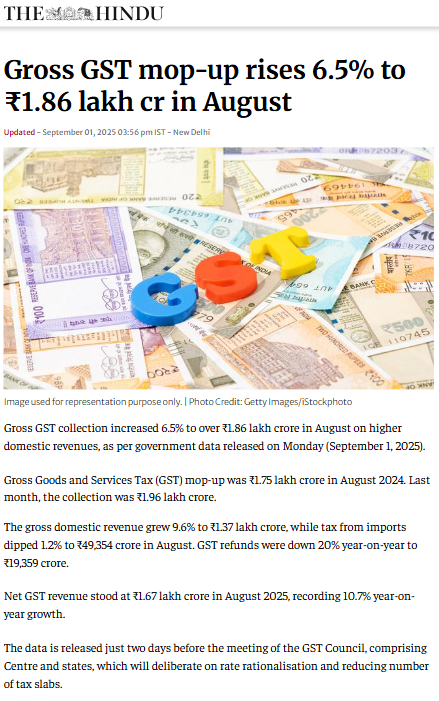
1195. Gross GST mop-up rises 6.5% to ₹1.86 lakh cr in August
- On September 1, 2025, government data showed gross GST collections in India rose 6.5% to over ₹1.86 lakh crore in August, driven by higher domestic revenues, ahead of the upcoming GST Council meeting.
- Domestic revenue growth of 9.6% to ₹1.37 lakh crore and lower GST refunds (down 20% YoY) contributed to a net GST of ₹1.67 lakh crore, while import tax declined 1.2%, reflecting improved compliance and collection efficiency.
- The rise in GST collections strengthens India’s fiscal position, providing a basis for rate rationalisation and potential tax slab reduction during the GST Council deliberations, impacting both Centre and state revenue policies.
Click here to find 1469 similar incidents of Bharat Economic Growth -> Bharat Economic Growth
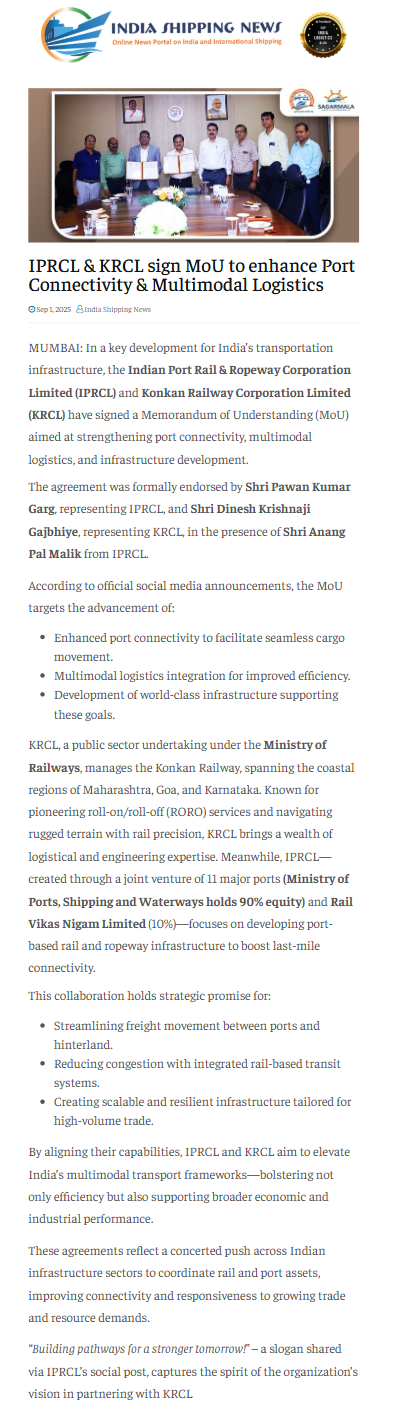
1196. IPRCL & KRCL sign MoU to enhance Port Connectivity & Multimodal Logistics Sep 1, 2025 India Shipping News
- On 1 September 2025, It was reported that, IPRCL and KRCL signed an MoU to enhance port connectivity, multimodal logistics, and infrastructure development across India, particularly targeting coastal regions of Maharashtra, Goa, and Karnataka.
- The collaboration aims to streamline freight movement, integrate rail-based transit systems, and reduce congestion, leveraging KRCL’s rail expertise and IPRCL’s port-based infrastructure capabilities for efficient and seamless cargo transportation.
- The partnership will create scalable, resilient multimodal infrastructure, boosting trade efficiency, industrial growth, and India’s overall economic performance, while strengthening last-mile connectivity between ports and the hinterland.
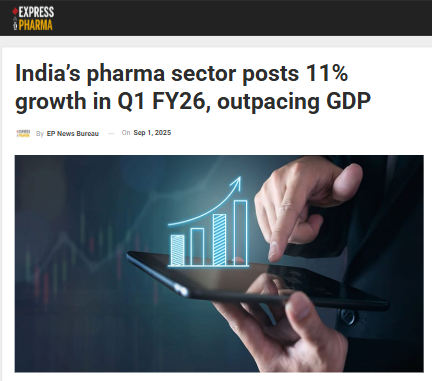
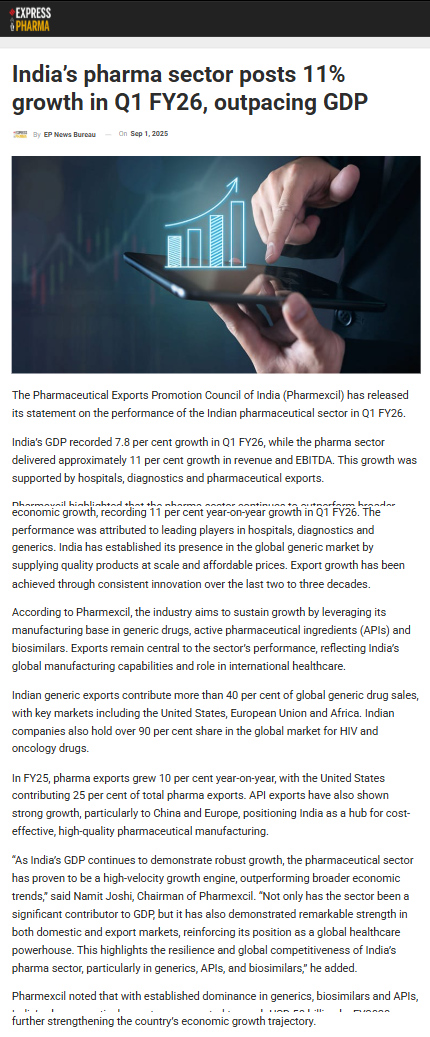
1197. India’s pharma sector posts 11% growth in Q1 FY26, outpacing GDP
- On 1 September 2025, It was Reported that, In Q1 FY26, India’s pharmaceutical sector delivered ~11% growth in revenue and EBITDA, outperforming the country’s 7.8% GDP growth, driven by hospitals, diagnostics, and pharmaceutical exports, highlighting the sector’s robust domestic and global performance.
- The growth is powered by generic drugs, APIs, and biosimilars, with Indian companies leveraging manufacturing scale, innovation, and quality to serve global markets, particularly the US, EU, Africa, and China, making exports central to sector performance.
- India holds over 40% of the global generic market and 90% of HIV and oncology drug supply, with pharma exports projected to reach USD 50 billion by FY2030, reinforcing India’s position as a global healthcare and pharmaceutical powerhouse.
Click here to find 860 similar incidents of Bharat Economic Growth -> Increasing Exports
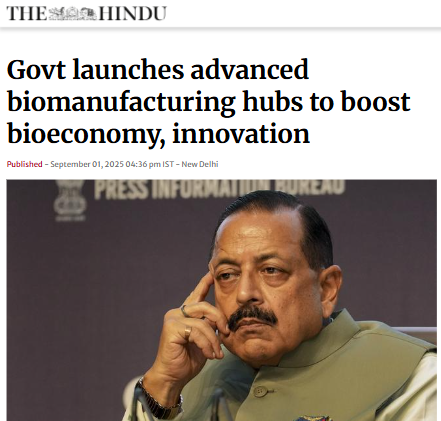
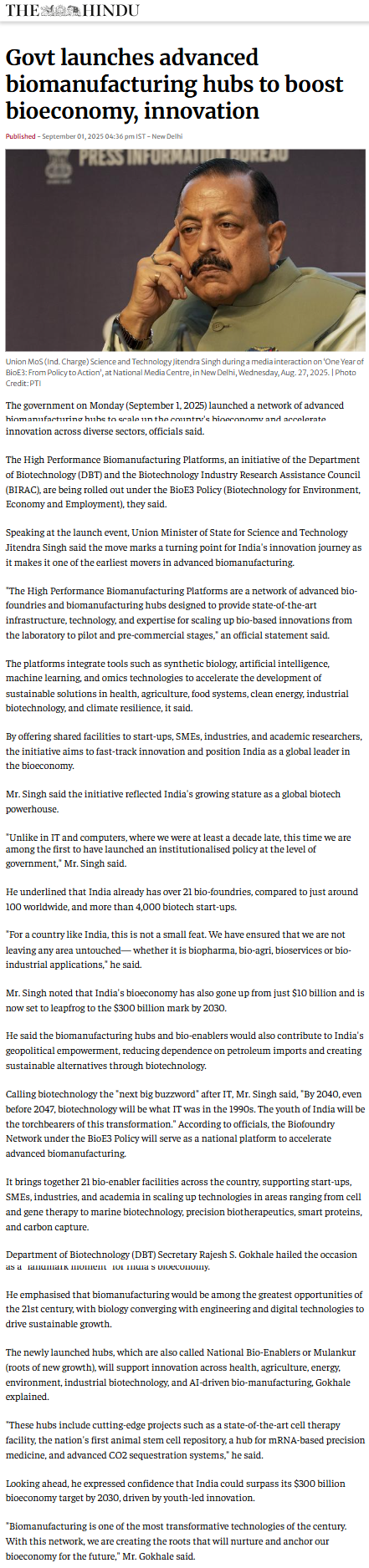
1198. Govt launches advanced biomanufacturing hubs to boost bioeconomy, innovation
- On September 1, 2025, India launched a network of High Performance Biomanufacturing Platforms under the BioE3 Policy, providing advanced bio-foundries and hubs nationwide to scale innovations from laboratory to pre-commercial stages across health, agriculture, energy, and industrial biotechnology.
- The initiative aims to accelerate India’s bioeconomy and innovation by integrating synthetic biology, AI, machine learning, and omics technologies. Shared facilities will support start-ups, SMEs, industries, and academia, reducing dependence on imports and fostering sustainable, bio-based solutions.
- India now has 21 bio-enabler hubs, contributing to a bioeconomy projected to grow from $10 billion to $300 billion by 2030. Key facilities include cell therapy labs, animal stem cell repositories, mRNA hubs, and CO₂ sequestration systems, positioning India as a global biotech leader.
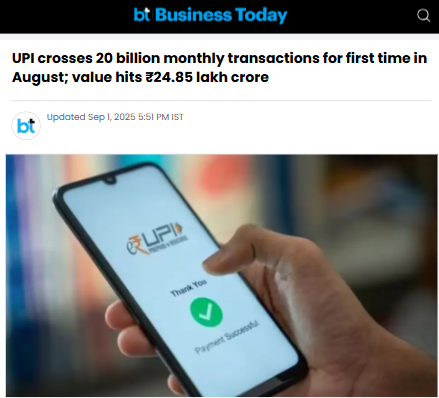
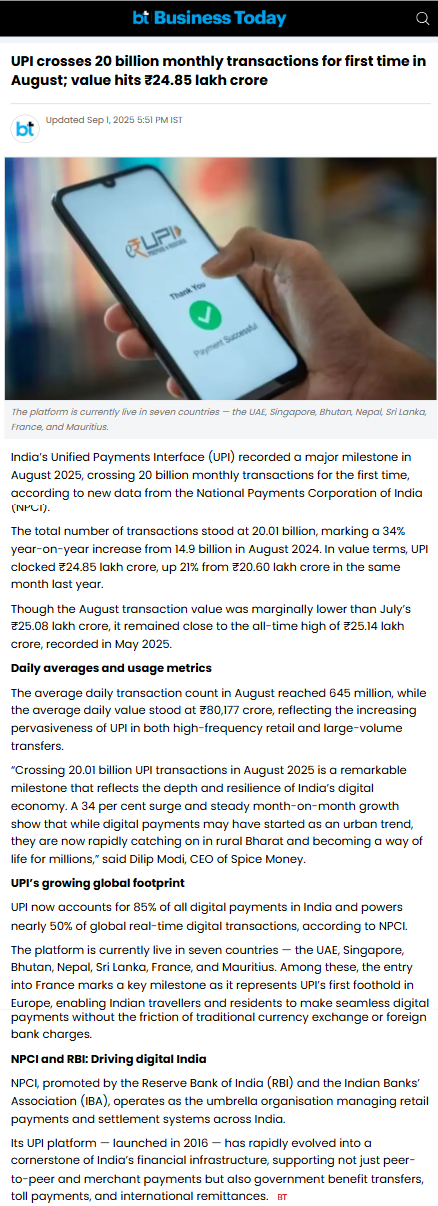
1199. UPI crosses 20 billion monthly transactions for first time in August; value hits ₹24.85 lakh crore
- On 1 September 2025 it was reported that, In August 2025, India’s Unified Payments Interface (UPI) crossed 20 billion monthly transactions, totaling ₹24.85 lakh crore, marking a 34% year-on-year increase. Average daily transactions reached 645 million, showing UPI’s widespread adoption across urban and rural India.
- Growth was driven by high-frequency retail and large-value transfers, reflecting UPI’s deep penetration. Daily transaction value averaged ₹80,177 crore. The system’s seamless, real-time digital payments and adoption in multiple sectors, including government transfers, fueled this milestone.
- UPI now accounts for 85% of India’s digital payments and nearly 50% of global real-time transactions. With availability in seven countries, including France as its first European market, UPI underscores India’s expanding digital economy and global fintech influence.
Click here to find 171 similar incidents of Bharat Economic Growth -> Digital Economy
1200. Manufacturing PMI rises to 17-year high of 59.3 in August 2025
- On 1 September it was reported that, In August 2025, India’s manufacturing sector expanded at the fastest rate in over 17 years, with the HSBC Manufacturing PMI rising to 59.3, reflecting the strongest improvement since 2008, driven by increased factory orders and production across the country.
- Growth was fueled by higher domestic demand, new orders, and production increases, with companies buying more materials and creating jobs. Advertising success and positive business expectations contributed, though export orders slowed due to the U.S. raising tariffs on Indian goods to 50%.
- Production volumes grew fastest in nearly five years, and new orders rose at the quickest pace in 57 months. The data reflects robust manufacturing recovery, strong domestic demand, and India’s improving competitiveness in global supply chains despite tariff-related challenges.
Click here to find 1469 similar incidents of Bharat Economic Growth -> Bharat Economic Growth