 Loading...
| Jan 01, 1970 | Daily Report |
| RISING BHARAT | News Count (102271) | |
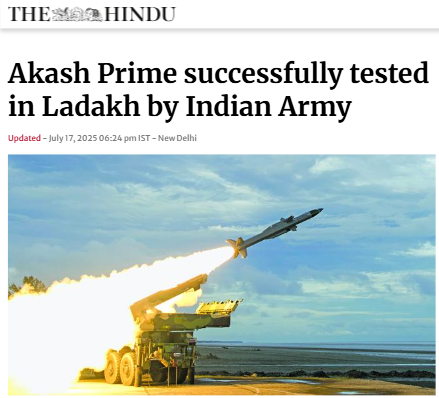
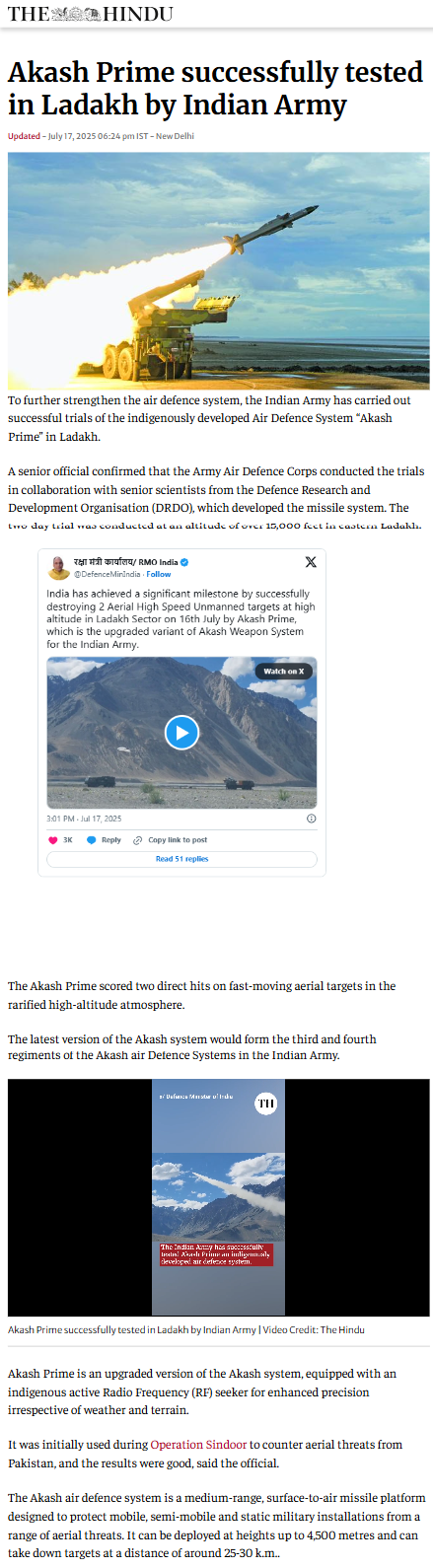
1581. Akash Prime successfully tested in Ladakh by Indian Army
- On 16 July, 2025 To bolster its air defence capabilities, the Indian Army successfully conducted trials of the indigenously developed “Akash Prime” air defence system in eastern Ladakh.
- A senior official confirmed that the Army Air Defence Corps carried out the trials in coordination with DRDO scientists. The two-day exercise took place at an altitude of over 15,000 feet.
- The Akash air defence system is a medium-range, surface-to-air missile platform designed to protect mobile, semi-mobile and static military installations from a range of aerial threats. It can be deployed at heights up to 4,500 metres and can take down targets at a distance of around 25-30 k.m.


1582. India's aviation has strong growth potential, holds only 4% of global traffic with 18% of world's population: Jefferies
- On 17 July, 2025 It was reported that, India’s aviation sector has significant untapped potential, accounting for just 4% of global air traffic despite representing nearly 18% of the world’s population,
- The report also noted that India is already the world’s third-largest aviation market by passenger volume, trailing only the United States and China.
- The report also mentioned that rising incomes, rapid urbanization, and ongoing investments in fleet expansion and airport infrastructure are expected to support sustained high single-digit to low double-digit growth in the industry.
Click here to find 1469 similar incidents of Bharat Economic Growth -> Bharat Economic Growth
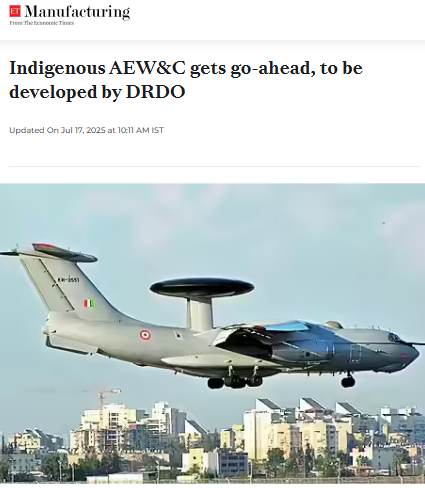
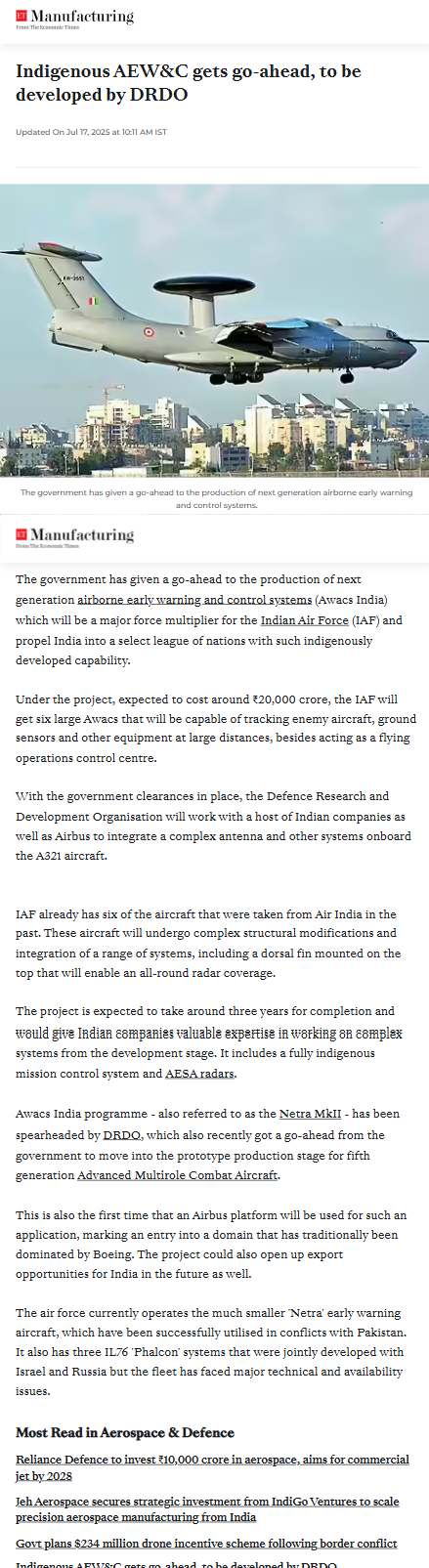
1583. Indigenous AEW&C gets go-ahead, to be developed by DRDO
- On July 17, 2025, the government approved the production of AWACS India, a next-gen airborne surveillance system, boosting IAF capabilities and placing India among a few nations with such indigenous tech.
- Under the ₹20,000 crore project, the IAF will receive six advanced AWACS capable of tracking enemy aircraft, ground sensors, and equipment over long distances, while also serving as airborne command centres.
- The project is expected to be completed in about three years and will provide Indian companies with vital experience in developing complex systems. It features a fully indigenous mission control system and AESA radars.
1584. Kanad's 'Parmanu' to ISRO missions, new NCERT textbook maps India's scientific legacy
- The New NCERT book integrates traditional knowledge with modern scientific education to foster curiosity, environmental awareness, ethical values, and critical thinking, highlighting India's traditional method for smallpox protection.
- Variolation, a practice predating Edward Jenner's vaccination work, is highlighted in a chapter on India's global health contributions. The text also discusses the Parmanu (atom) concept, referencing ancient Indian philosopher Charya Kanad.
- The book explores ancient Indian texts, including the use of alloys for medicinal purposes. It also discusses ISRO missions, including Chandrayaan 1, 2, and 3, and the use of mirrors and lenses for observing stars and planets in the sky.
- Class 8 students learn about Major Somnath Sharma and the Battle of Budgam in the updated NCERT English textbook. The Class 5 English textbook, 'Santoor', features illustrations of women in various roles, promoting women's representation in local bodies, water conservation, and sports like 'Gilli Danda' and hockey.
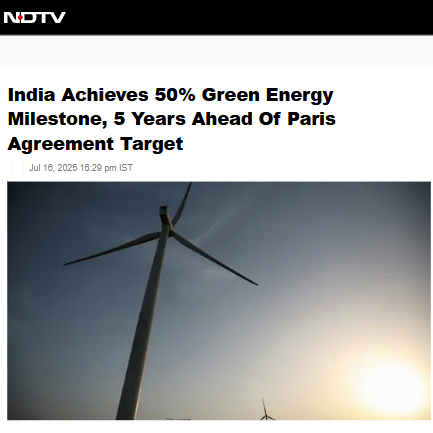

1585. India Achieves 50% Green Energy Milestone, 5 Years Ahead Of Paris Agreement Target
- As per July 16, 2025, India has hit a major clean energy milestone, achieving 50 per cent of its installed electricity capacity from non-fossil fuel sources, five years ahead of the 2030 target set under the Paris Agreement.
- According to official data, the country's total power generation capacity now stands at 484.8 GW, of which over 234 GW comes from non-fossil fuel sources, including solar, wind, large hydro, and nuclear.
- In the first half of 2025, India's renewable power generation surged rapidly, the fastest since 2022, while coal-fired generation dipped nearly 3 per cent. The country added nearly 28 GW of solar and wind power in 2024 and 16.3 GW more between January and May this year 2025.
- As of June-end, excluding large hydro, renewable energy accounted for about 184.6 GW.
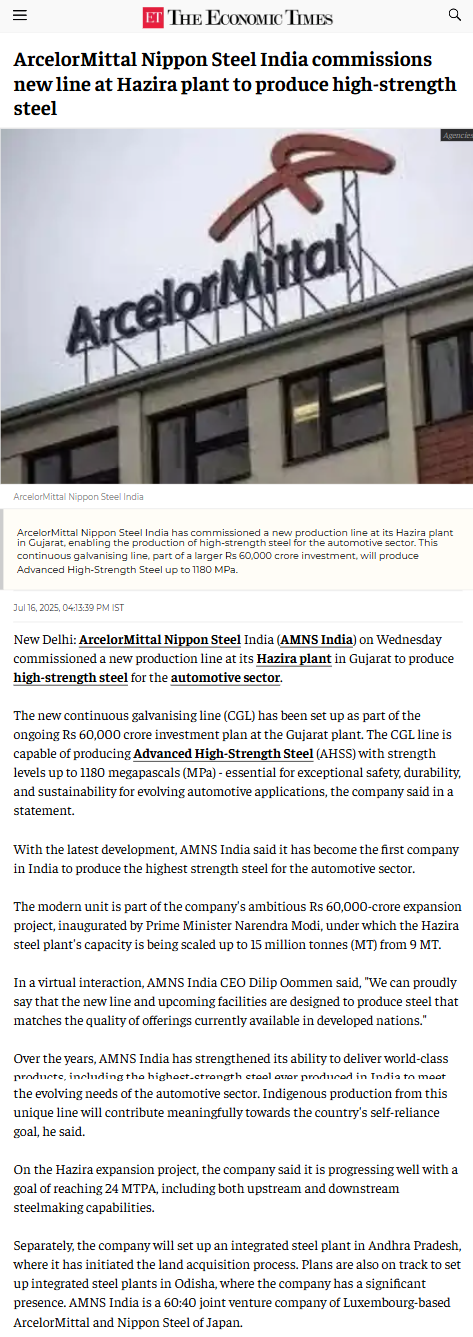
1586. ArcelorMittal Nippon Steel India commissions new line at Hazira plant to produce high-strength steel
- On July 16, 2025, ArcelorMittal Nippon Steel India has commissioned a new production line at its Hazira plant in Gujarat, capable of producing high-strength steel for the automotive sector, as part of an ongoing Rs 60,000 crore investment plan.
- AMNS India has become the first Indian company to produce the highest strength steel for the automotive sector, as part of its ambitious Rs 60,000-crore expansion project.
- AMNS India is enhancing its steel production capabilities to meet the automotive sector's needs, contributing to India's self-reliance goal.
- The company is aiming for 24 MTPA in the Hazira expansion project and plans to establish integrated steel plants in Andhra Pradesh and Odisha. AMNS India is a joint venture between ArcelorMittal and Nippon Steel.
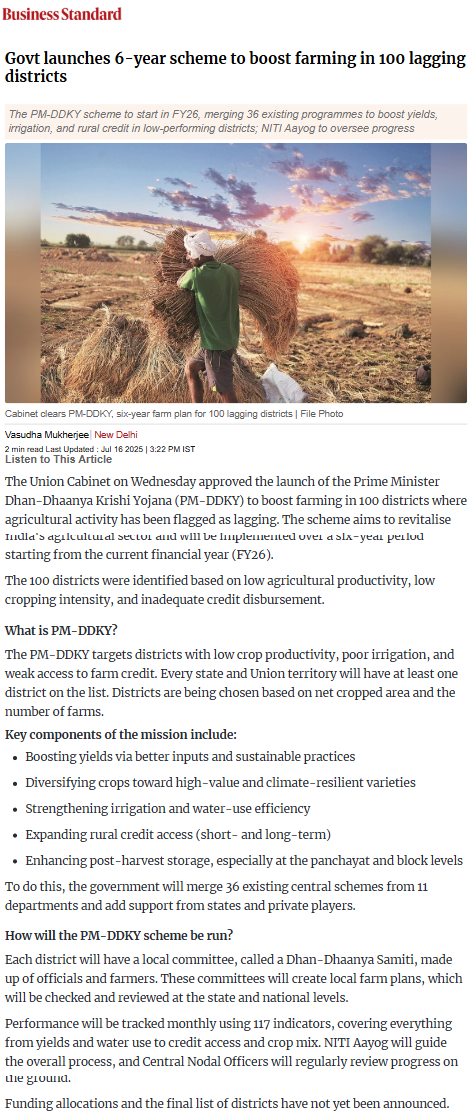
1587. Govt launches 6-year scheme to boost farming in 100 lagging districts
- On July 16, 2025, Union Cabinet approved the PM-DDKY, a six-year scheme aimed at revitalising India's agricultural sector, to boost farming in 100 lagging districts identified for low productivity, cropping intensity, and inadequate credit disbursement.
- The PM-DDKY aims to improve crop productivity, irrigation, and farm credit access in districts with low cropped area and farms. Key components include sustainable practices, crop diversification, improved irrigation, expanded rural credit access, and post-harvest storage. Government merges central schemes from 11 departments.
- Districts will have local committees, Dhan-Dhaanya Samiti, to create farm plans, reviewed at state and national levels. Performance will be tracked using 117 indicators, guided by NITI Aayog. Funding allocations and districts' final list are yet to be announced.
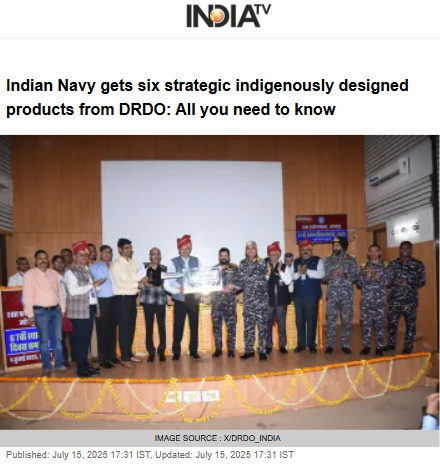
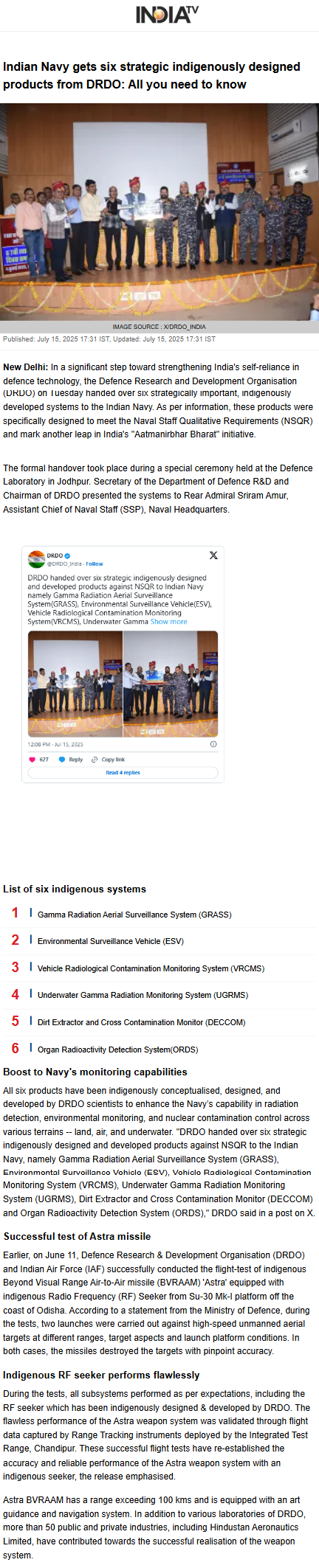
1588. Indian Navy gets six strategic indigenously designed products from DRDO: All you need to know
- On 15 July 2025, during a special ceremony at the Defence Laboratory in Jodhpur, the Defence Research and Development Organisation (DRDO) handed over six strategically important, indigenously developed systems to the Indian Navy — marking a significant step toward strengthening India's self-reliance in defence technology.
- All six products have been indigenously conceptualised, designed, and developed by DRDO scientists to enhance the Navy’s capability in radiation detection, environmental monitoring, and nuclear contamination control across various terrains -- land, air, and underwater.
- As per information, these products were specifically designed to meet the Naval Staff Qualitative Requirements (NSQR) and mark another leap in India's "Aatmanirbhar Bharat" initiative.
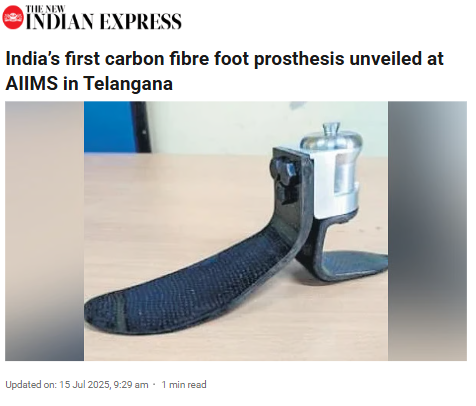
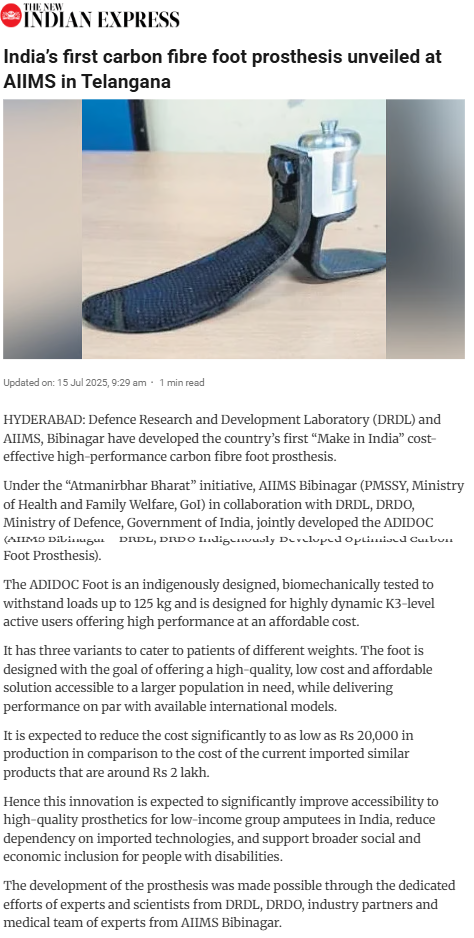
1589. India’s first carbon fibre foot prosthesis unveiled at AIIMS in Telangana
- On 14 July, 2025, Defence Research and Development Laboratory (DRDL) and AIIMS, Bibinagar have developed the country’s first “Make in India” cost-effective high-performance carbon fibre foot prosthesis.
- Under the “Atmanirbhar Bharat” initiative, AIIMS Bibinagar (PMSSY, Ministry of Health and Family Welfare, GoI) in collaboration with DRDL, DRDO, Ministry of Defence, Government of India, jointly developed the ADIDOC (AIIMS Bibinagar - DRDL, DRDO Indigenously Developed Optimised Carbon Foot Prosthesis).
- The foot comes in three variants for different weight categories and aims to provide a high-quality, low-cost alternative to costly imports. With performance matching international models, it is expected to reduce production costs to around ₹20,000, compared to ₹2 lakh for similar imported products.
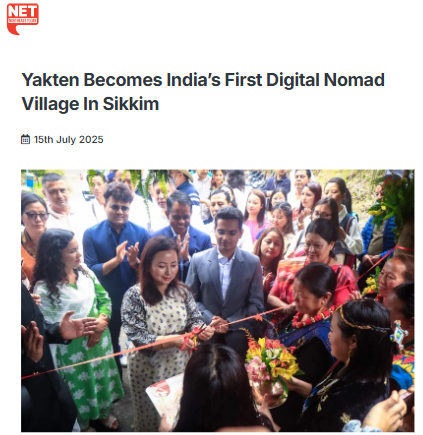
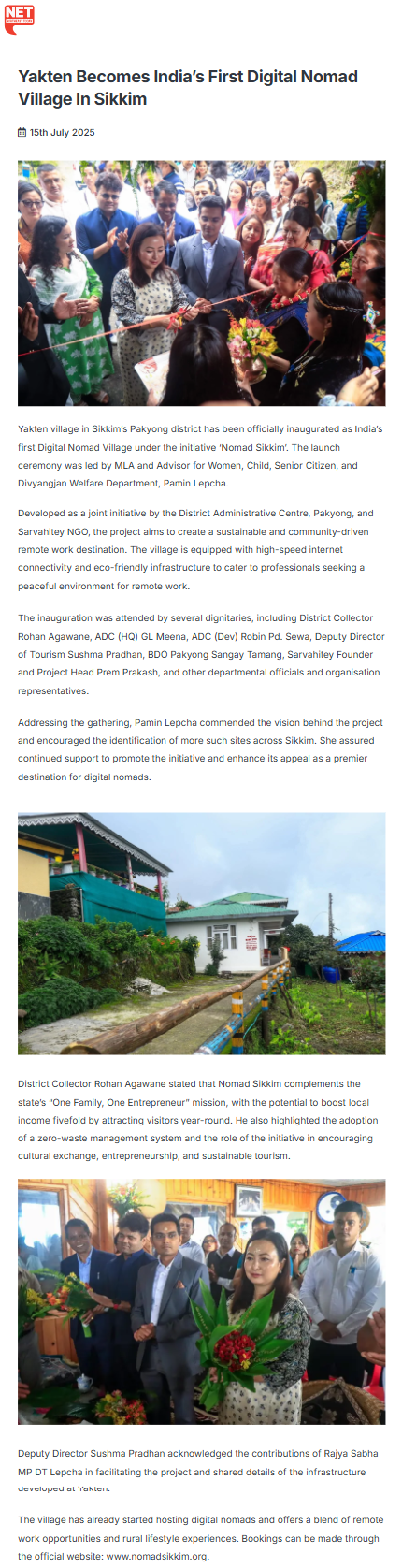
1590. Yakten Becomes India’s First Digital Nomad Village In Sikkim
- On 14 July, 2025, Yakten village in Sikkim’s Pakyong district has been officially inaugurated as India’s first Digital Nomad Village under the initiative ‘Nomad Sikkim’.
- Developed as a joint initiative by the District Administrative Centre, Pakyong, and Sarvahitey NGO, the project aims to create a sustainable and community-driven remote work destination.The village is equipped with high-speed internet connectivity and eco-friendly infrastructure to cater to professionals seeking a peaceful environment for remote work.
- The inauguration was attended by several dignitaries, including District Collector Rohan Agawane, ADC (HQ) GL Meena, ADC (Dev) Robin Pd. Sewa, Deputy Director of Tourism Sushma Pradhan, BDO Pakyong Sangay Tamang, Sarvahitey Founder and Project Head Prem Prakash, and other departmental officials and organisation representatives.
Click here to find 219 similar incidents of North East India -> Developments in North East India