 Loading...
| Jan 01, 1970 | Daily Report |
| RISING BHARAT | News Count (102282) | |
1431. Renewable Energy Capacity in India’s Power Mix Reaches 48.3% in Q2 2025
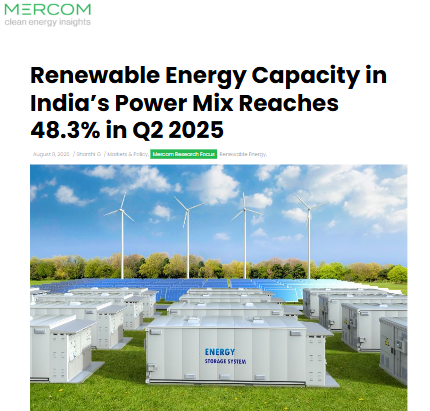
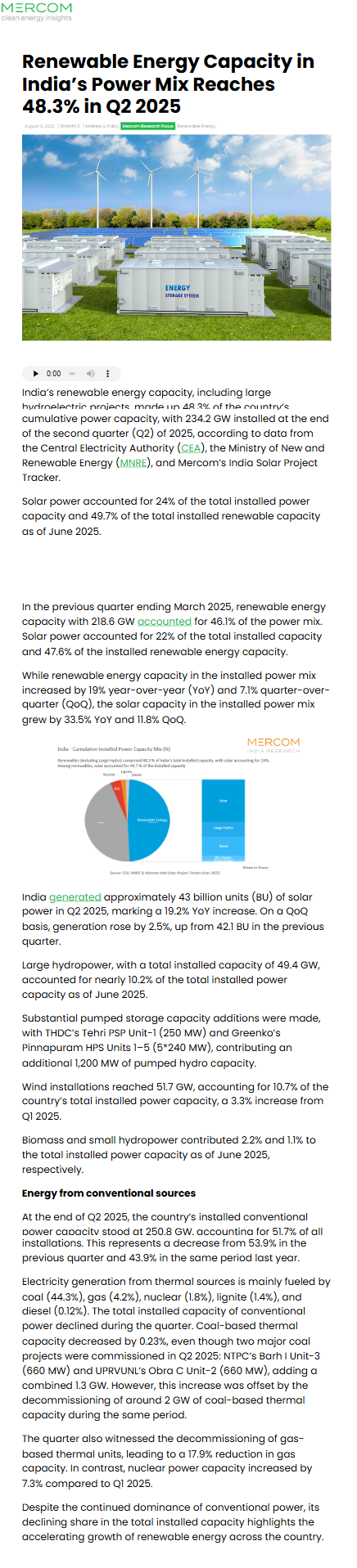
- On 8 August 2025, According to data from the Central Electricity Authority (CEA), MNRE, and Mercom’s India Solar Project Tracker, by June 2025 (Q2) India’s renewable energy capacity, including large hydro, reached 234.2 GW—48.3% of the total installed power capacity. Solar alone accounted for 24% of the total power mix and 49.7% of renewables.
- The growth is driven by increased solar and wind installations, large hydropower projects, and pumped storage additions like THDC’s Tehri PSP (250 MW) and Greenko’s Pinnapuram HPS (1,200 MW). Renewable capacity rose 19% YoY and 7.1% QoQ, with solar capacity alone growing 33.5% YoY and generating 43 BU in Q2 2025.
- While conventional power still accounts for 51.7% of installed capacity (250.8 GW), its share is falling from 53.9% in Q1 2025. Coal remains dominant at 44.3% but saw net capacity decline due to 2 GW decommissioning. The trend signals accelerating renewable adoption and reduced reliance on conventional energy sources in India’s power mix.
1432. OIL, IREL Ink Pact To Boost Critical Mineral Development
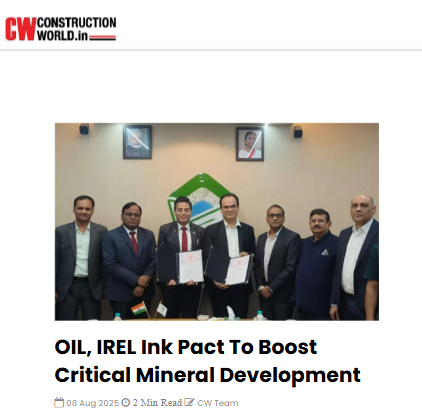
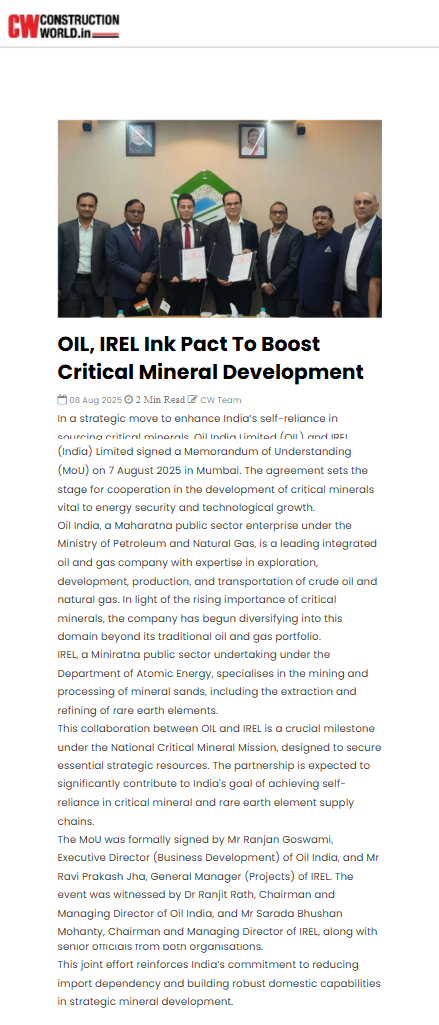
- On 7 August 2025 in Mumbai, Oil India Limited (OIL) and IREL (India) Limited, a Memorandum of Understanding (MoU) was signed to cooperate in developing critical minerals essential for energy security and technological growth, marking a strategic expansion beyond OIL’s traditional oil and gas portfolio.
- The collaboration aims to support the National Critical Mineral Mission by securing rare earth elements and other vital resources. OIL will bring its exploration and production expertise, while IREL contributes its mining and refining capabilities, enabling India to reduce import dependency and strengthen self-reliance in critical mineral supply chains.
- The MoU was signed by Ranjan Goswami of OIL and Ravi Prakash Jha of IREL, in the presence of both companies’ CMDs. This partnership is a milestone in building robust domestic capabilities, ensuring strategic resource availability, and reinforcing India’s long-term commitment to energy security and industrial growth.
1433. India’s Electronics Exports Surge 47% in Q1 FY26, Driven by Mobile Phones: ICEA
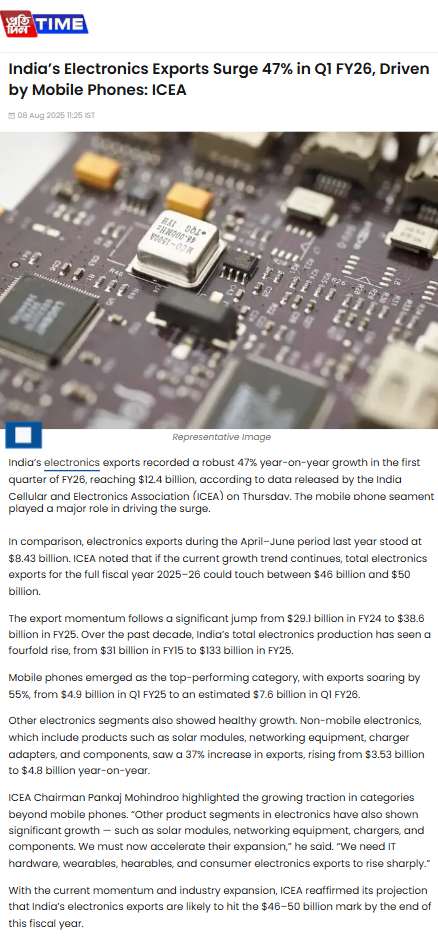
- According to data released by the India Cellular and Electronics Association (ICEA) on 7 August, 2025, in April–June (Q1) FY26, India’s electronics exports reached $12.4 billion, a 47% year-on-year increase from $8.43 billion in Q1 FY25, driven mainly by a 55% surge in mobile phone exports.
- Exports rose due to increasing global demand, expanded domestic production, and government policy support. Growth was led by mobile phones, followed by a 37% increase in non-mobile electronics such as solar modules, networking equipment, chargers, and components, reflecting India’s broader manufacturing capacity improvement.
- ICEA projects electronics exports could reach $46–50 billion in FY26, up from $38.6 billion in FY25 and $29.1 billion in FY24. Over the past decade, India’s electronics production has quadrupled from $31 billion in FY15 to $133 billion in FY25 marking a major milestone in manufacturing growth.
Click here to find 860 similar incidents of Bharat Economic Growth -> Increasing Exports
1434. Over ₹309cr sanctioned for ‘Kavach’ installation in North Central Railway
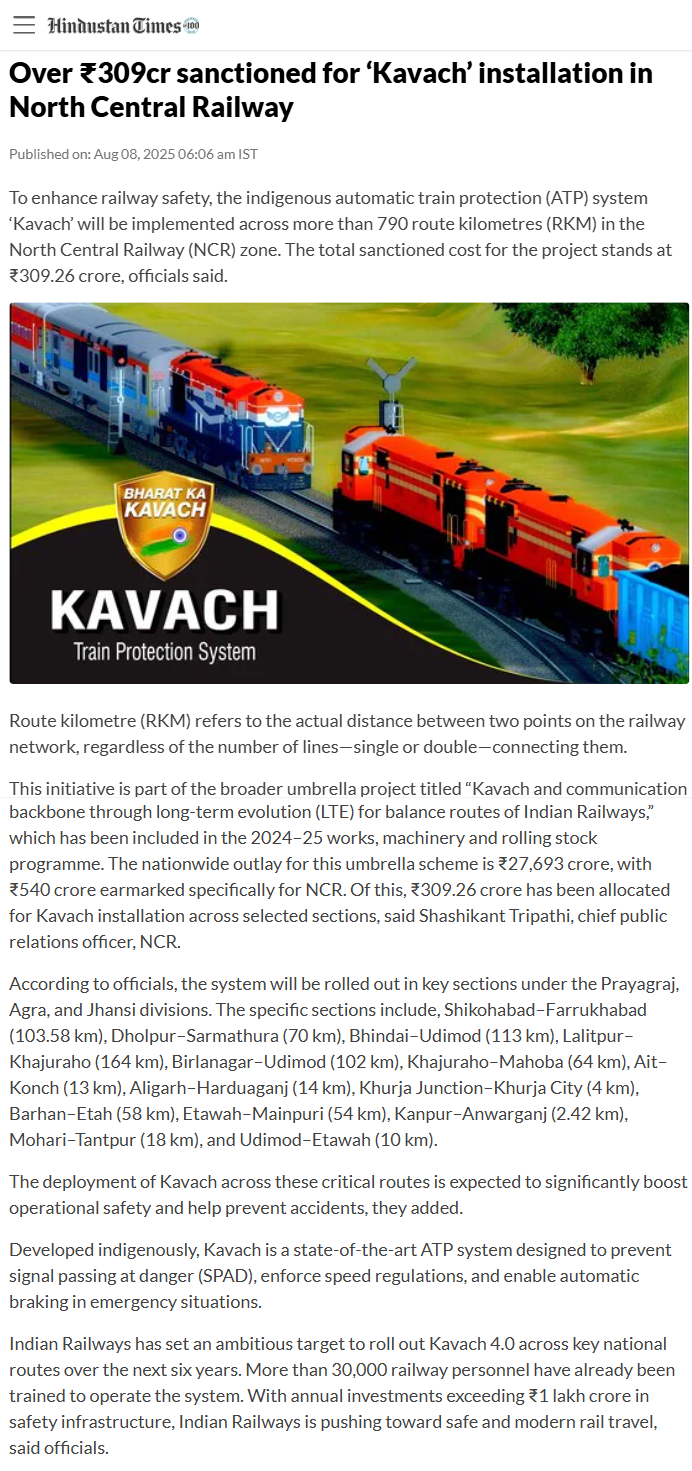
- On August 8, 2025, Indian Railways sanctioned over ₹309 crore for the installation of the indigenous ‘Kavach’ automatic train protection system across more than 790 route kilometres in the North Central Railway (NCR) zone.
- The Kavach system will be deployed in key sections under the Prayagraj, Agra, and Jhansi divisions. This is part of a ₹27,693 crore national project, with ₹540 crore allocated to NCR and ₹309.26 crore earmarked for Kavach. The system prevents signal passing at danger (SPAD), regulates train speed, and enables emergency braking. Over 30,000 personnel have been trained to operate it.
- This project aims to significantly enhance operational safety and prevent accidents on critical rail routes. It is a step toward Indian Railways’ broader mission to modernize safety infrastructure with annual investments exceeding ₹1 lakh crore.
1435. Railways open J&K’s Anantnag station for goods transport
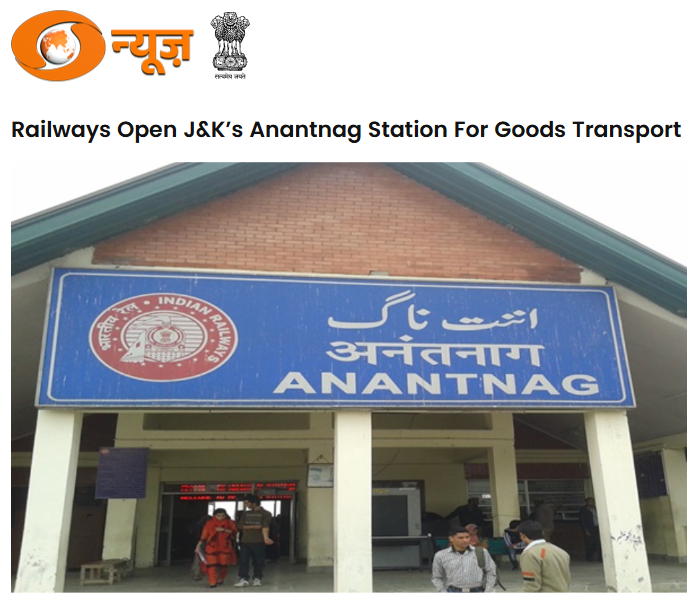
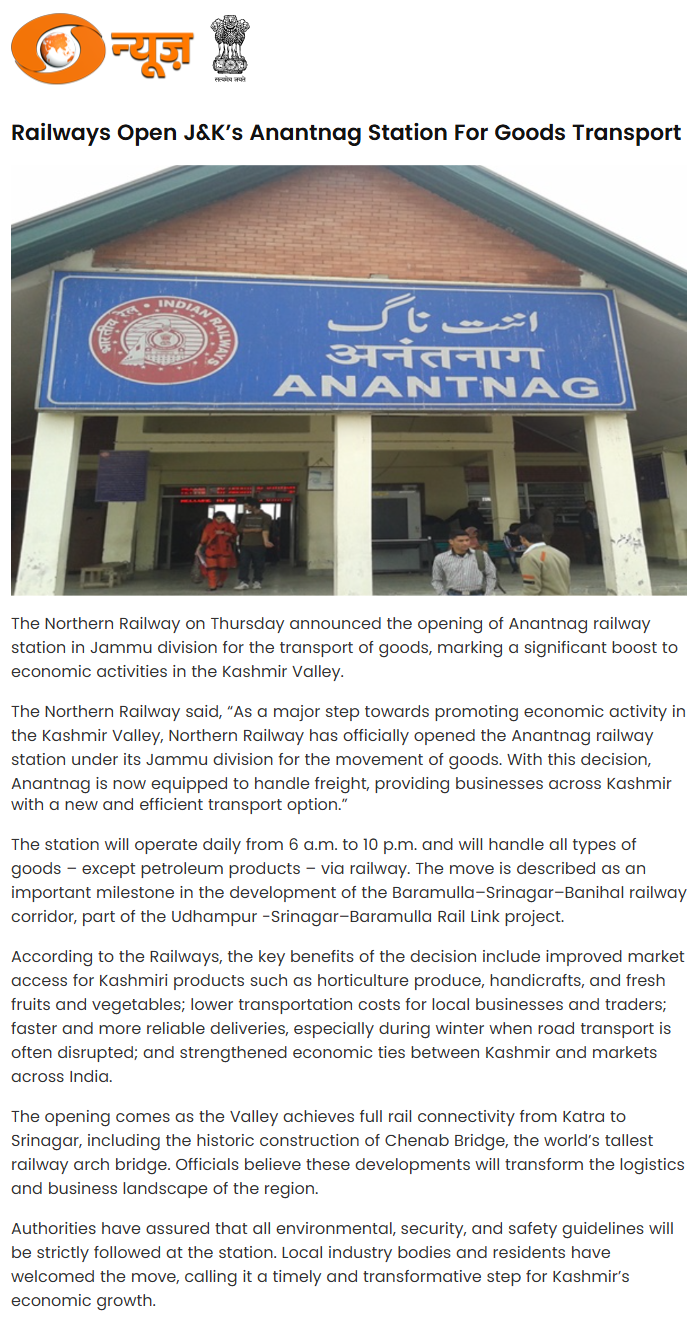
- On August 7, 2025, Northern Railway announced the opening of Anantnag railway station in Jammu & Kashmir for the transport of goods, marking a major step toward promoting economic activities in the Kashmir Valley.
- The station is part of the Jammu division and the Udhampur-Srinagar-Baramulla Rail Link project, will operate daily from 6 a.m. to 10 p.m. to handle all types of goods except petroleum products. Now the Valley has full rail connectivity from Katra to Srinagar, including the world's highest railway bridge over the Chenab River.
- The project is expected to lower transport costs, improve delivery speed, and give Kashmir’s horticulture, handicrafts, and fresh produce better access to national markets—especially crucial during harsh winters.
1436. Indian Railways Approves ₹309 Cr Budget To Install ‘Kavach’ On 14 Key Rail Sections Of UP & MP To Prevent Accidents
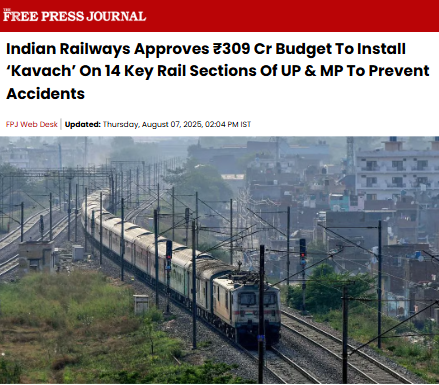
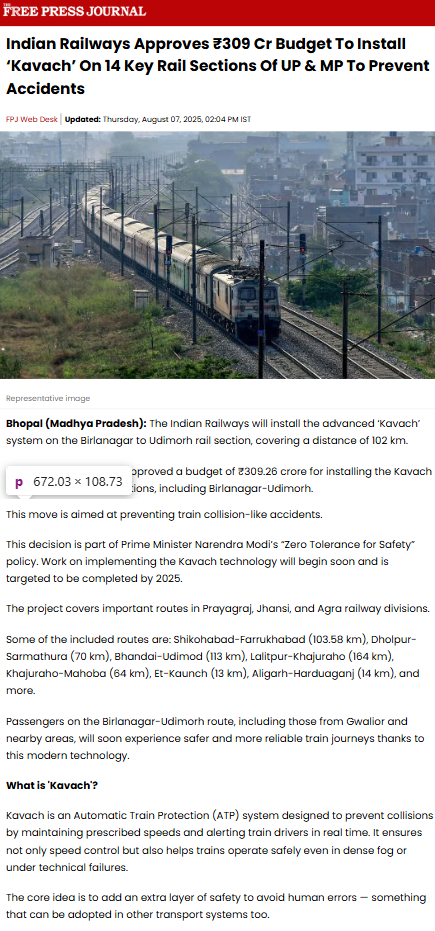
- On August 7, 2025, Indian Railways announced the installation of the Kavach ATP system on the Birlanagar-Udimorh rail route (102 km), as part of a larger ₹309.26 crore safety project covering 14 key railway sections.
- Kavach works by automatically controlling train speed, issuing real-time alerts to drivers, and preventing collisions, even in low-visibility conditions like fog. This move is part of the government’s Zero Tolerance for Safety approach to reduce human errors and enhance operational reliability.
- The project covers critical routes in Prayagraj, Jhansi, and Agra divisions, including sections like Shikohabad-Farrukhabad, Lalitpur-Khajuraho, Aligarh-Harduaganj, and more. Passengers in Gwalior and surrounding areas will soon benefit from safer, more dependable train travel, with implementation targeted for completion by 2025.
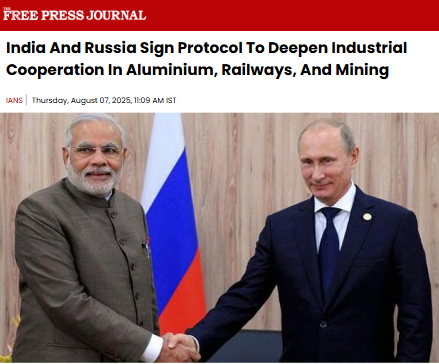
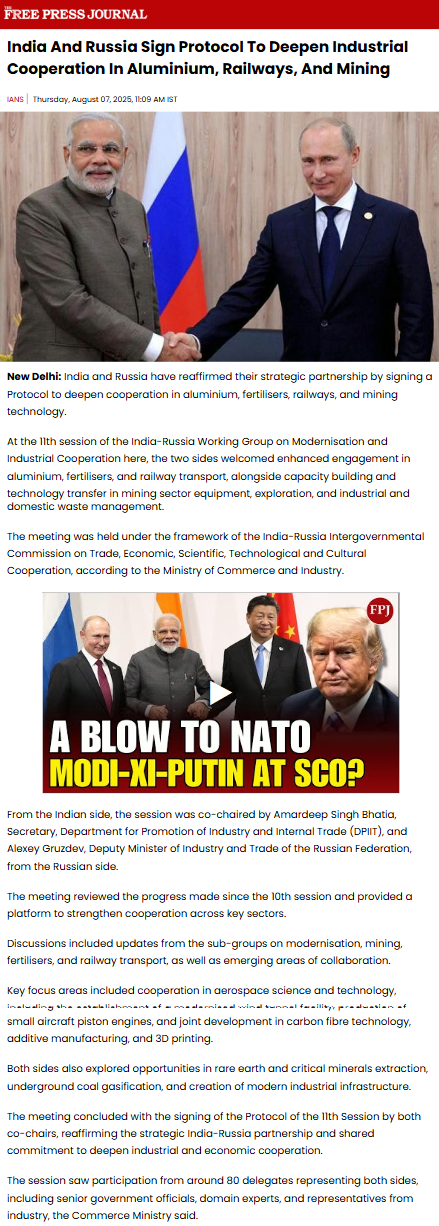
1437. India And Russia Sign Protocol To Deepen Industrial Cooperation In Aluminium, Railways, And Mining
- On August 6, 2025, India and Russia held the 11th session of their Working Group on Modernisation and Industrial Cooperation at Vanijya Bhawan, New Delhi, co-chaired by officials from DPIIT (India) and the Russian Ministry of Industry and Trade.
- The session focused on cooperation in aerospace technology, small aircraft engine production, 3D printing, carbon fibre, and critical minerals extraction, aiming to review progress since the 10th session and promote technology transfer, industrial infrastructure, and sustainable development.
- The session concluded with the signing of a Protocol, reaffirming the strategic India-Russia partnership. About 80 delegates from both nations participated. Separately, Russia’s Deputy Defence Minister met India’s Ambassador in Moscow, reflecting ongoing high-level defence cooperation in a warm and trusted diplomatic atmosphere.
Click here to find 870 similar incidents of Indian Diplomacy -> Diplomatic Initiatives
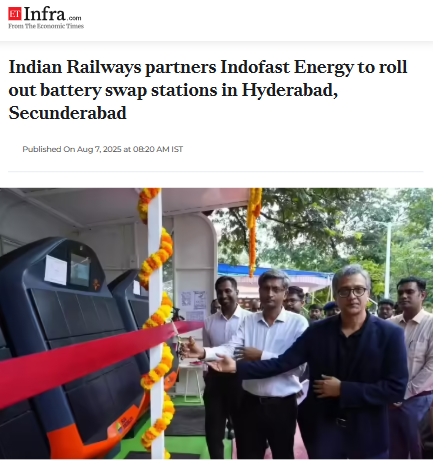
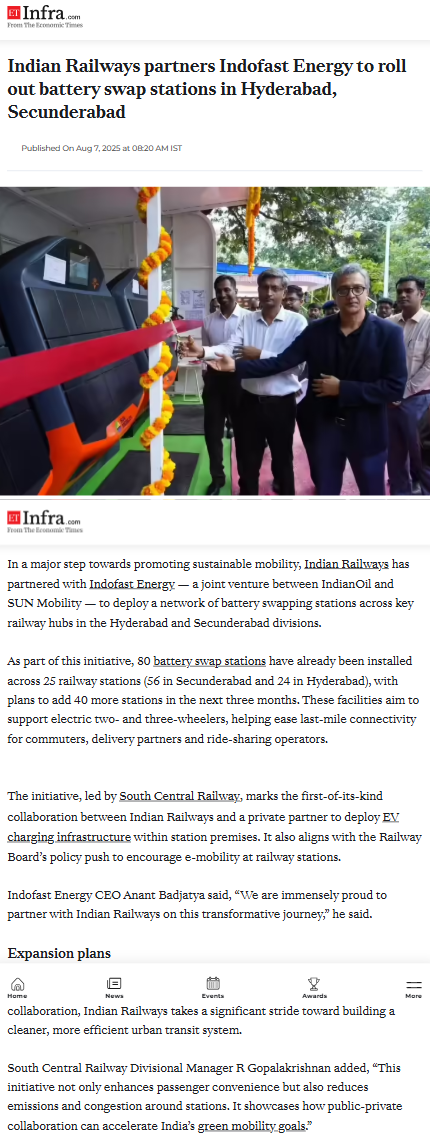
1438. Indian Railways partners Indofast Energy to roll out battery swap stations in Hyderabad, Secunderabad
- On August 7, 2025, It was reported that, Indian Railways partnered with Indofast Energy to install 80 battery swapping stations across 25 key railway stations (56 in Secunderabad and 24 in Hyderabad), with plans to add 40 more in the next three months.
- Led by South Central Railway, these swap stations are set up within station premises to support electric two- and three-wheelers, aiming to improve last-mile connectivity for commuters, delivery partners, and ride-sharing operators, while promoting the Railway Board’s e-mobility vision.
- With a vision to reach over one million EV users, Indofast Energy plans to install 10,000+ battery swapping stations across 40+ cities in the next three years a major stride toward building a cleaner and more efficient urban transport ecosystem.
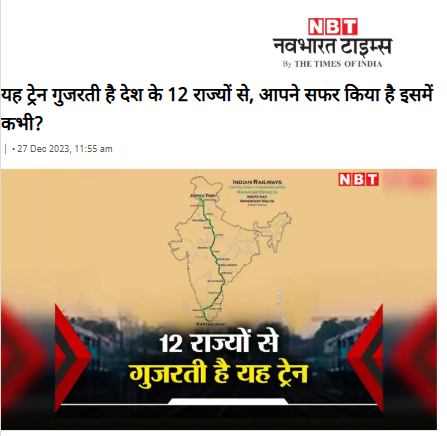

1439. भारत की सबसे लम्बी दूरी की ट्रेन हिमसागर एक्सप्रेस (जम्मू से कन्याकुमारी तक) को पहली बार हरी झंडी दिखाई गई।
- 3 अक्टूबर 1984 को जम्मू-कश्मीर से 16317 / 16318 हिमसागर एक्सप्रेस को पहली बार हरी झंडी दिखाकर कन्याकुमारी के लिए रवाना किया गया था, और यह उस समय देश की सबसे लंबी दूरी तय करने वाली ट्रेन थी।
- यह ट्रेन जम्मू-कश्मीर के कटड़ा से चलकर तमिलनाडु के कन्याकुमारी तक 3,790 किमी की दूरी 73 घंटों में तय करती है, और मार्ग में 69 रेलवे स्टेशनों पर रुकती है।
- हिमसागर एक्सप्रेस 12 राज्यों से होकर गुजरती है , जम्मू-कश्मीर, पंजाब, हरियाणा, दिल्ली, उत्तर प्रदेश, राजस्थान, मध्य प्रदेश, महाराष्ट्र, आंध्र प्रदेश, तेलंगाना, केरल और तमिलनाडु। यह ट्रेन वर्तमान में दुनिया में 35वीं, और भारत में तीसरी सबसे लंबी दूरी तय करने वाली ट्रेन है।
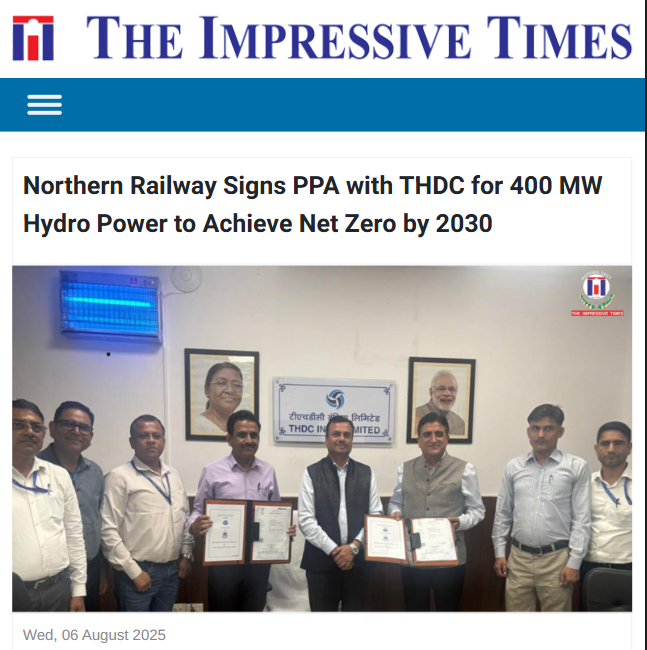
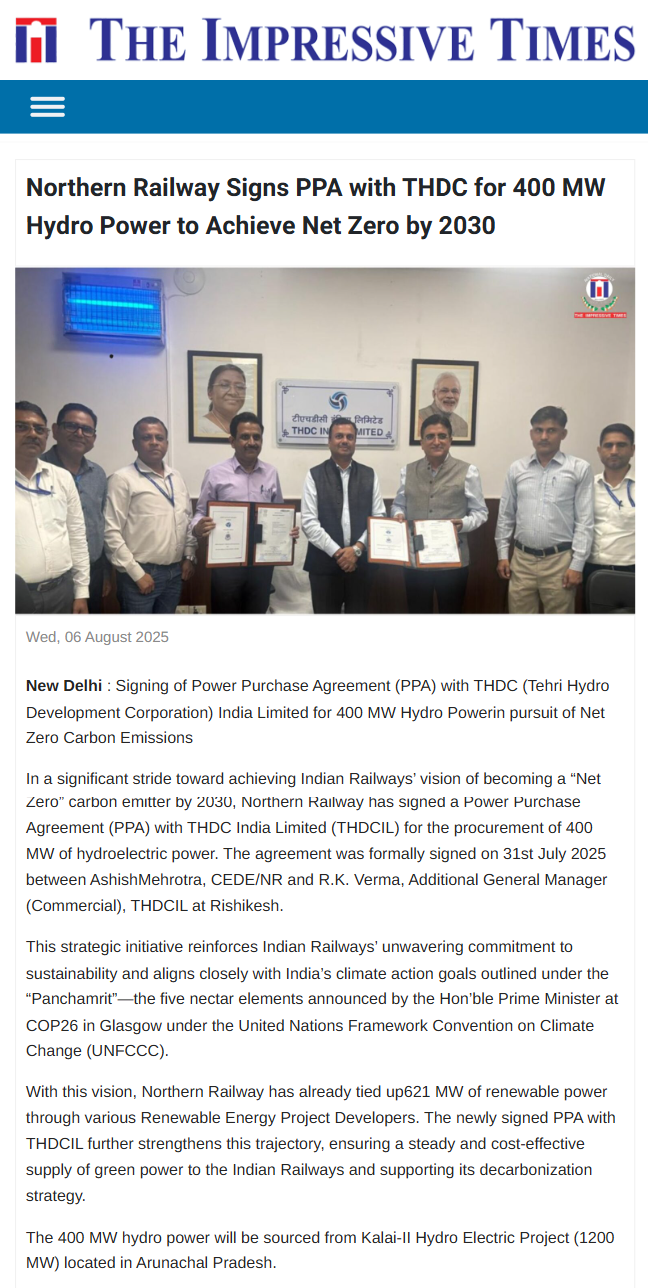
1440. Northern Railway Signs PPA with THDC for 400 MW Hydro Power to Achieve Net Zero by 2030
- On July 31, 2025, Northern Railway signed a Power Purchase Agreement (PPA) with THDC India Limited (THDCIL) for 400 MW of hydroelectric power to move towards becoming a Net Zero carbon emitter by 2030.
- The agreement was signed in Rishikesh between Northern Railway’s CEDE and THDCIL’s. The power will come from the Kalai-II Hydro Electric Project (1200 MW) in Arunachal Pradesh. Northern Railway has already secured 621 MW of renewable energy from other developers, and this deal further boosts its green power capacity.
- The initiative supports Indian Railways’ sustainability goals, ensures a steady supply of clean energy, and aligns with India’s climate commitments under the “Panchamrit” announced at COP26.