 Loading...
| Jan 01, 1970 | Daily Report |
| RISING BHARAT | News Count (102269) | |

471. UPI volumes rise to record 21.63 billion in Dec; around ₹300 lakh crore of UPI transactions made in CY2025
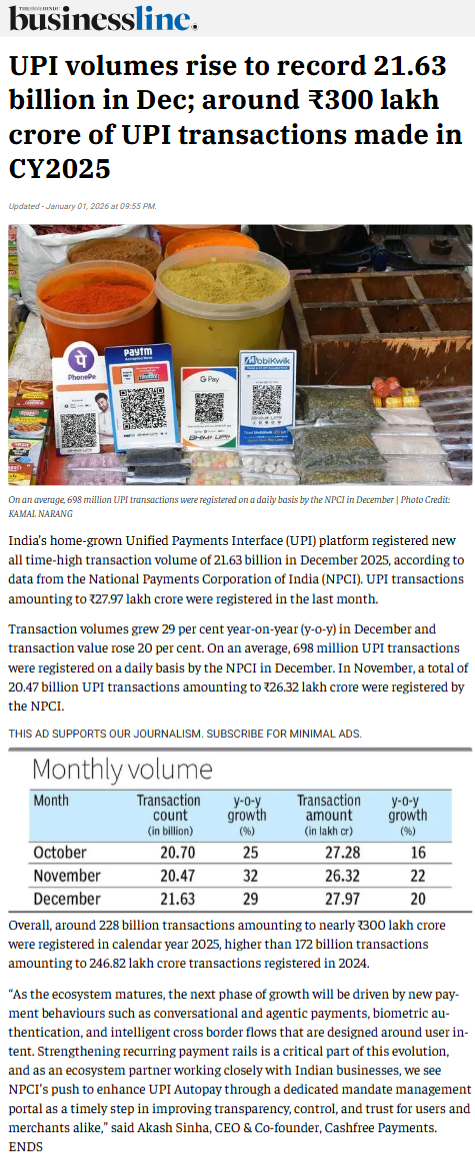
- On January 1, 2025, It was reported that, In December 2025, India’s UPI platform recorded an all-time high of 21.63 billion transactions worth ₹27.97 lakh crore, according to the NPCI, marking strong nationwide digital payment growth.
- NPCI and Cashfree Payments CEO Akash Sinha explained that growth will be driven by conversational payments, biometric authentication, agentic flows, and improved user control through a dedicated UPI Autopay mandate management portal.
- UPI saw 29% y-o-y volume growth and 20% value growth in December, averaging 698 million daily transactions. 2025 totals reached 228 billion transactions worth nearly ₹300 lakh crore, up from 172 billion and ₹246.82 lakh crore in 2024.
Click here to find 171 similar incidents of Bharat Economic Growth -> Digital Economy
472. Delhi's rooftop solar push Surya Ghar scheme, ₹17,000 cr upgrade to meet rising power demand
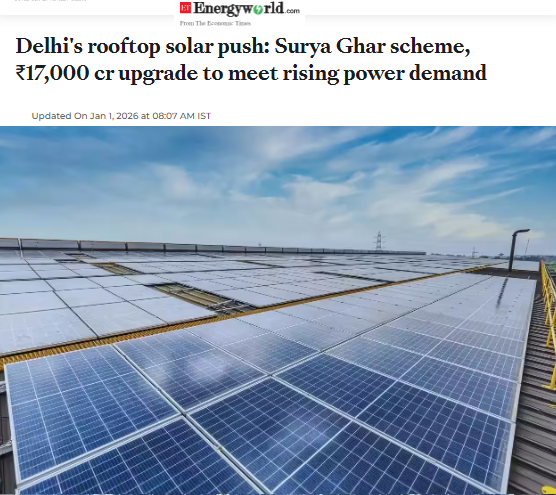
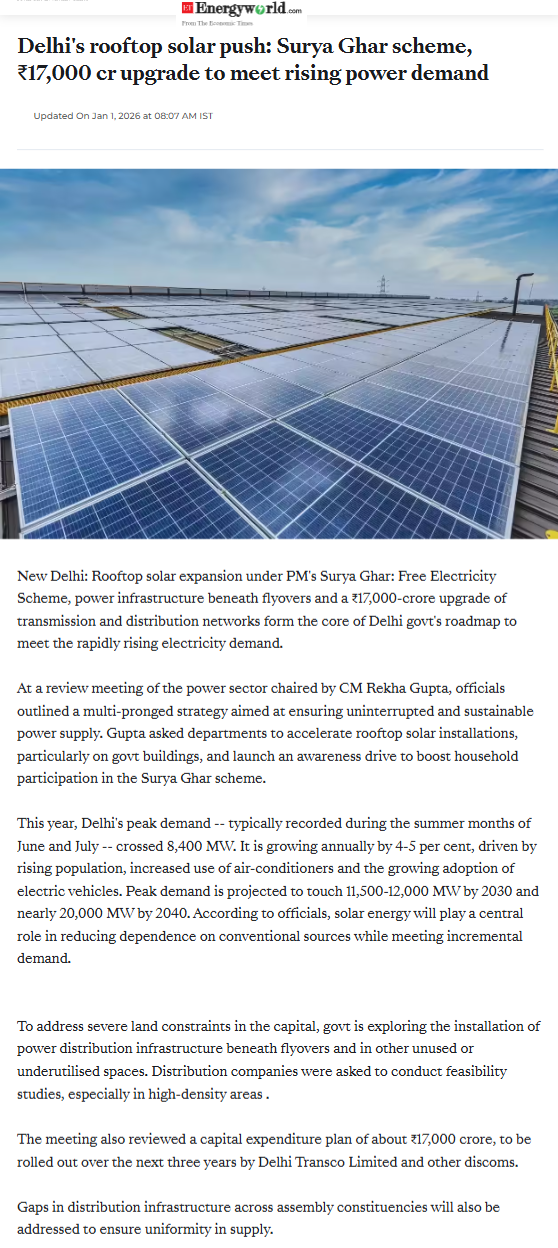
- On January 1,2026, the Delhi government, led by Chief Minister has unveiled a comprehensive plan to expand rooftop solar energy under the PM’s Surya Ghar Free Electricity Scheme and to modernize the city’s power systems with a ₹17,000‑crore investment in transmission and distribution infrastructure, aiming for uninterrupted and sustainable electricity supply.
- Announced at a power sector review meeting in December 2025, the strategy responds to surging electricity demand in Delhi which peaked above 8,400 MW in 2025 and is expected to rise to about 11,500–12,000 MW by 2030 and nearly 20,000 MW by 2040 driven by population growth, increased air‑conditioner use, and electric vehicles, with solar energy positioned as a core solution to reduce dependence on conventional sources and meet future needs.
- The plan boosts rooftop solar, makes innovative use of limited spaces, and strengthens Delhi’s power infrastructure with a ₹17,000‑crore investment.
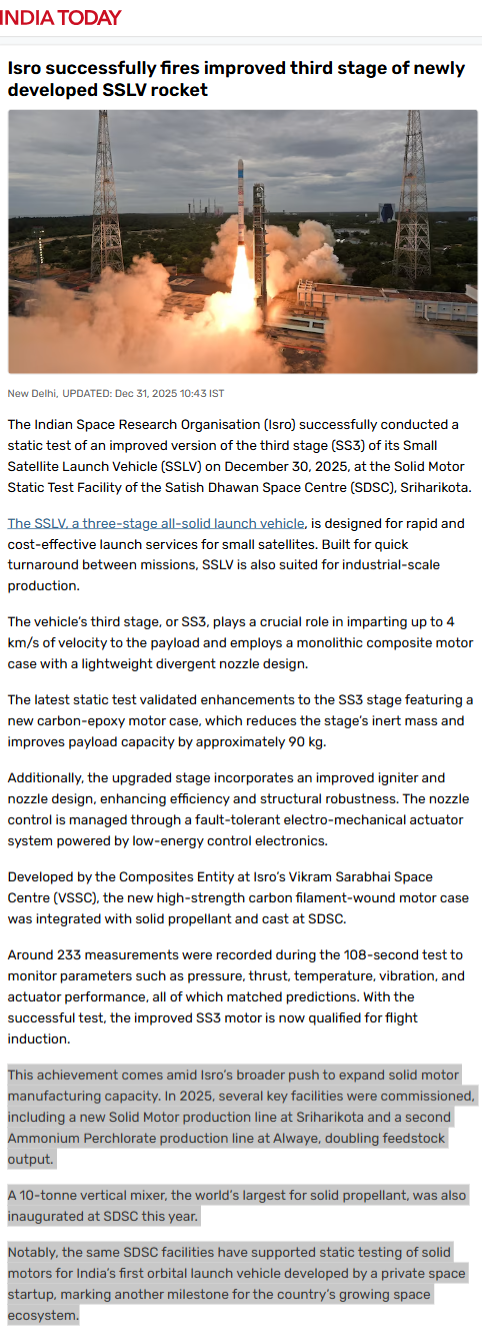
473. Isro successfully fires improved third stage of newly developed SSLV rocket
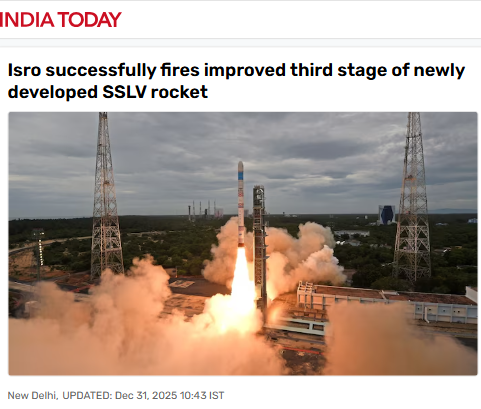
- On December 30,2025,ISRO successfully conducted a static test of the improved third stage (SS3) of the Small Satellite Launch Vehicle (SSLV) at the Satish Dhawan Space Centre (SDSC), Sriharikota, qualifying the upgraded motor for flight use.
- The upgraded SS3 features a lightweight carbon-epoxy motor case, improved igniter and nozzle, and a fault-tolerant electro-mechanical control system, reducing inert mass and increasing payload capacity by about 90 kg, with all test parameters performing as expected.
- This development supports ISRO’s goal of rapid, cost-effective small satellite launches and higher launch frequency, alongside expanded solid motor manufacturing facilities that strengthen India’s growing space and private launch ecosystem.
Click here to find 461 similar incidents of Make in India / Atmanirbhar -> Space
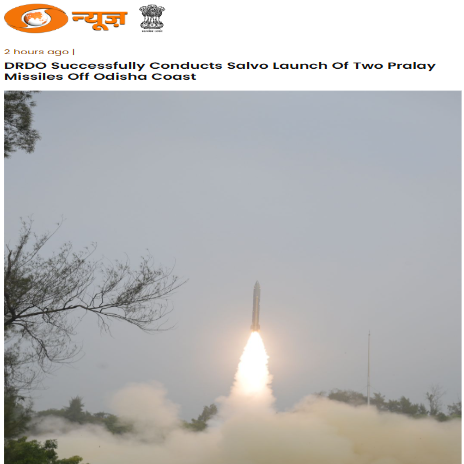
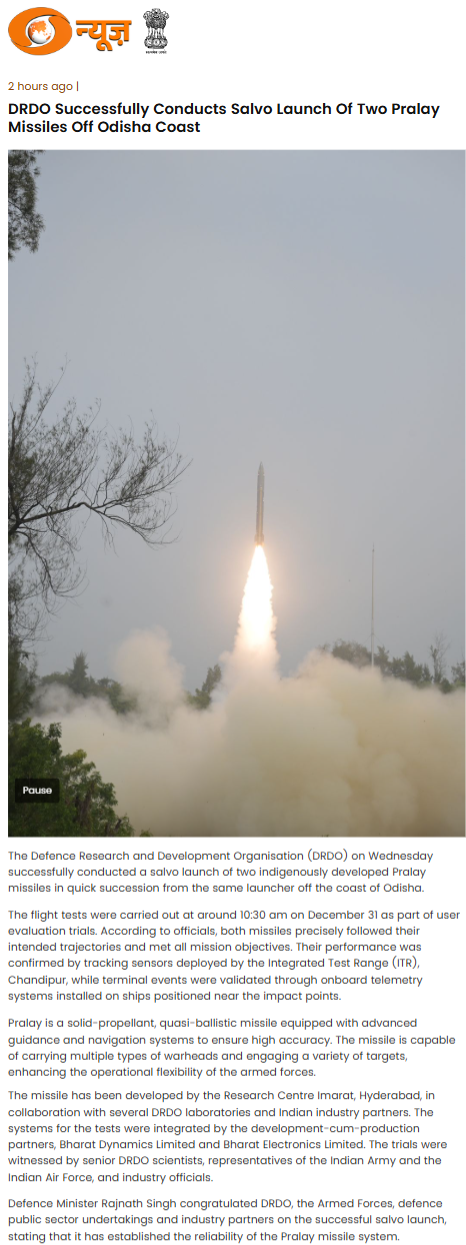
474. DRDO successfully conducts Salvo launch of two Pralay missiles off Odisha coast
- On December 31 at 10:30 am, DRDO conducted two back-to-back Pralay missile launches during user evaluation trials from a single launcher off the Odisha coast, with both missiles accurately following predetermined trajectories.
- DRDO, supported by RCI Hyderabad, multiple labs, BDL, BEL, and armed forces observers, executed the trials using solid-propellant, quasi-ballistic Pralay missiles guided by advanced navigation, telemetry, and tracking systems.
- Pralay carries diverse warheads, ensures high accuracy through onboard guidance, and offers operational flexibility. Tracking sensors at ITR and ship-borne telemetry validated terminal events. Defence Minister of India praised the launch for proving system reliability.
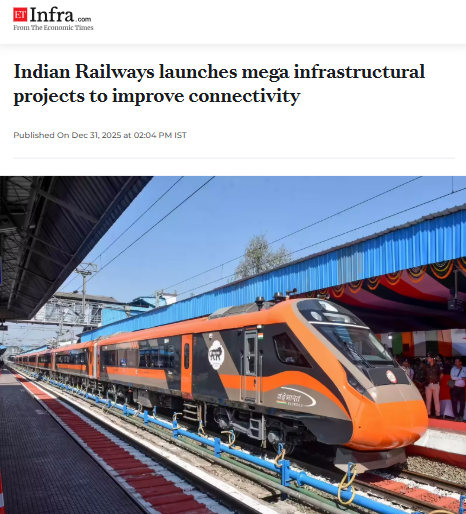
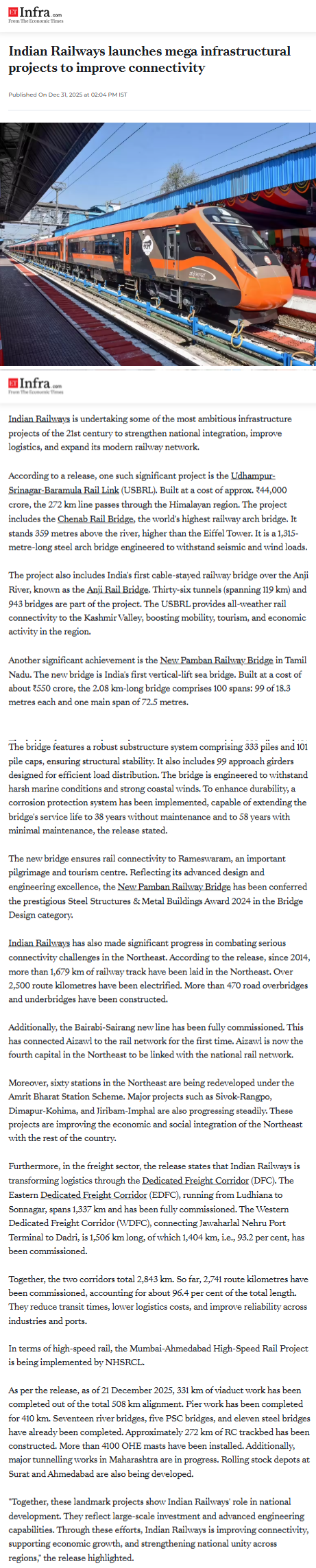
475. Indian Railways launches mega infrastructural projects to improve connectivity
- On December 31, 2025 It was reported that, From 2014 to December 2025, Indian Railways executed major infrastructure works across Jammu & Kashmir, Tamil Nadu, the Northeast, and the Western–Eastern corridors, building rail links, sea bridges, and high-speed networks to enhance national connectivity.
- Indian Railways, with agencies like NHSRCL, implemented these projects through advanced engineering—arch bridges, vertical-lift systems, cable-stayed structures, heavy tunnelling, electrification, viaduct construction, and freight corridors—using modern materials, seismic design, wind-resistant systems, and large-scale civil works.
- USBRL cost ₹44,000 crore with 36 tunnels and 943 bridges; New Pamban Bridge spans 2.08 km; DFCs commissioned 2,741 km; Northeast added 1,679 km of track; Mumbai–Ahmedabad HSR completed 331 km viaduct and 410 km piers.

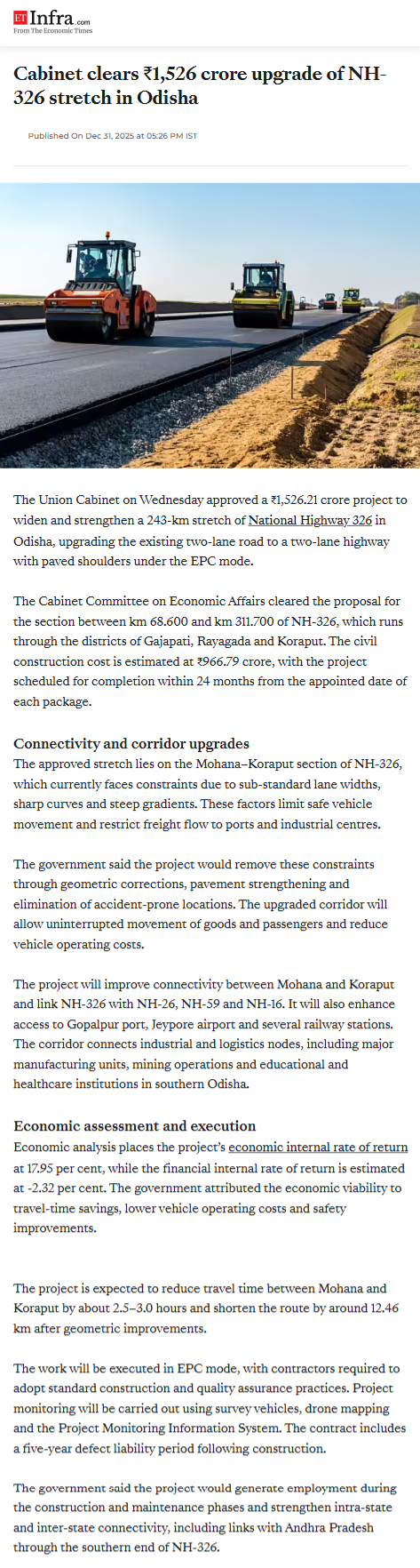
476. Cabinet clears ₹1,526 crore upgrade of NH-326 stretch in Odisha
- On December 31,2025,The Union Cabinet approved a ₹1,526 crore project to upgrade a 243-km stretch of NH-326 in Odisha between Mohana and Koraput, converting it into a two-lane highway with paved shoulders under the EPC mode.
- The project aims to fix narrow lanes, sharp curves, and steep gradients to improve road safety, freight movement, and passenger travel, cutting travel time by 2.5–3 hours and reducing vehicle costs.
- Passing through Gajapati, Rayagada, and Koraput districts, the upgraded corridor will strengthen links to NH-26, NH-59, and NH-16, improve access to ports and airports, and boost regional connectivity, jobs, and economic growth.
Click here to find 427 similar incidents of Make in India / Atmanirbhar -> Roads and Highways
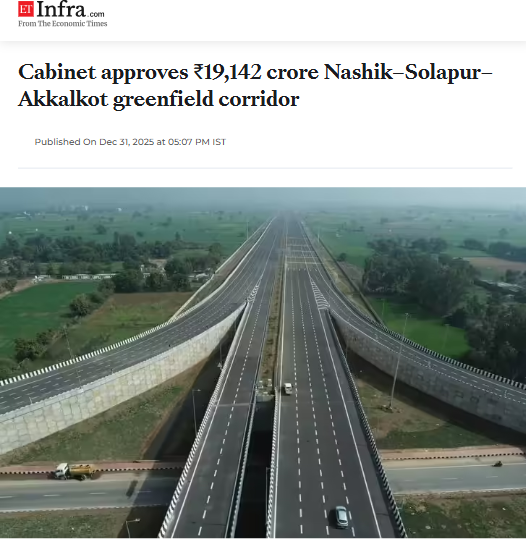
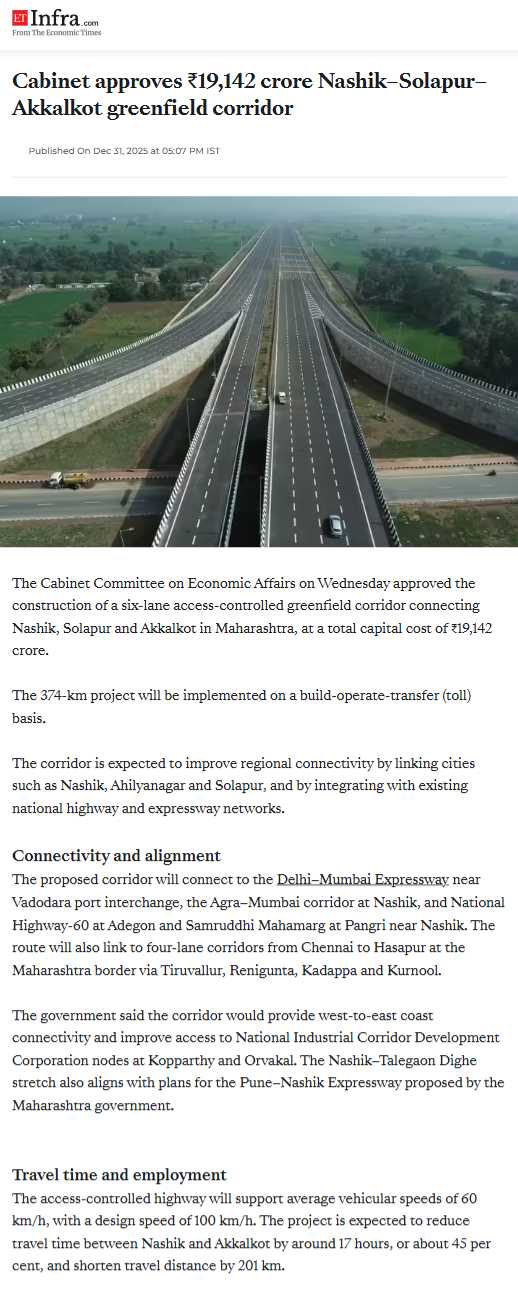
477. Cabinet approves ₹19,142 crore Nashik–Solapur–Akkalkot greenfield corridor
- On December 31,2025, the Cabinet Committee on Economic Affairs approved a ₹19,142 crore, 374-km six-lane access-controlled greenfield corridor connecting Nashik–Solapur–Akkalkot in Maharashtra, to be developed under the BOT (toll) model.
- The corridor will link major routes including the Delhi–Mumbai Expressway, Agra–Mumbai corridor, Samruddhi Mahamarg and NH-60, enabling west-to-east coast connectivity, with a design speed of 100 km/h and average speed of 60 km/h.
- The project will reduce travel time by about 17 hours (45%), shorten distance by 201 km, and generate around 251 lakh direct and 314 lakh indirect man-days of employment, boosting regional and industrial development in Maharashtra.
Click here to find 427 similar incidents of Make in India / Atmanirbhar -> Roads and Highways
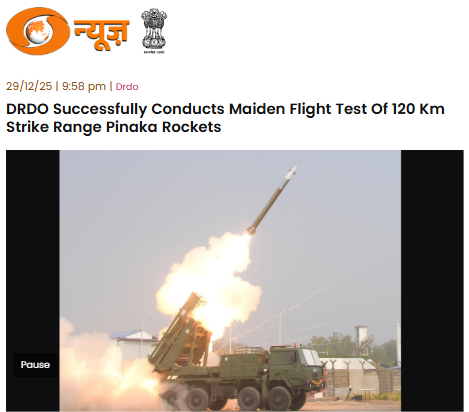
478. DRDO successfully conducts maiden flight test of 120 Km strike range Pinaka rockets
- On December 29, 2025 India successfully conducted the maiden flight test of the Pinaka Long Range Guided Rocket (LRGR-120) at the Integrated Test Range in Chandipur, Odisha, coinciding with its same-day induction clearance by the Defence Acquisition Council.
- DRDO laboratories—ARDE, HEMRL, DRDL, and RCI—developed the 120-km LRGR, which was launched from an in-service Pinaka launcher and tracked throughout its flight, executing planned manoeuvres and hitting its target with textbook precision.
- The test was coordinated by ITR and PXE. Defence Minister Rajnath Singh and DRDO Chief Samir V. Kamat praised the achievement. Pinaka MLRS, already exported to Armenia and drawing European interest, may replace alternative artillery plans once longer-range variants mature.
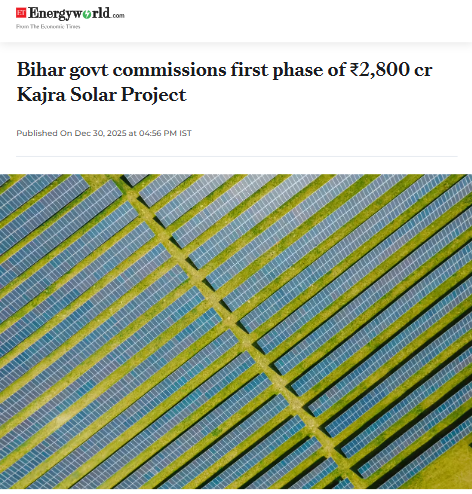
479. Bihar govt commissions first phase of ₹2,800 cr Kajra Solar Project
- On December 30, 2025, Bihar commissioned the first phase of the ₹2,800 crore Kajra Solar Power Plant in Lakhisarai district, marking a significant expansion of the state’s clean and renewable energy infrastructure.
- Bihar Energy Secretary Manoj Kumar Singh announced that a 185 MW solar unit with a 254 MWh battery system was completed, using energised transmission and transformer facilities to ensure four to five hours of uninterrupted peak-time electricity.
- The second phase will add a 116 MW solar plant and a 241 MWh battery system by January 2027, bringing the Kajra project’s total capacity to 301 MW and total storage capacity to 495 MWh.


480. Union Civil Aviation Minister flags off next-generation helicopter Dhruv NG in Bengaluru
- On December 30, 2025, Union Civil Aviation Minister flagged off the inaugural flight of HAL’s next-generation Dhruv NG civil helicopter at HAL, marking its formal entry into India’s civil aviation sector.
- HAL engineers created the Dhruv NG with twin Shakti 1H1C engines, a civil-certified glass cockpit, advanced avionics, crashworthy systems, and vibration control, enabling safe, multi-role civil operations across challenging Indian terrain.
- The 5.5-tonne Dhruv NG offers 285 km/h speed, 630 km range, 6,000-metre ceiling, 1,000-kg payload, a 7.33 m³ configurable cabin for VIP, medical, and offshore roles, and serves as a cost-effective alternative to imported twin-engine helicopters.