 Loading...
| Jan 01, 1970 | Daily Report |
| RISING BHARAT | News Count (102145) | |
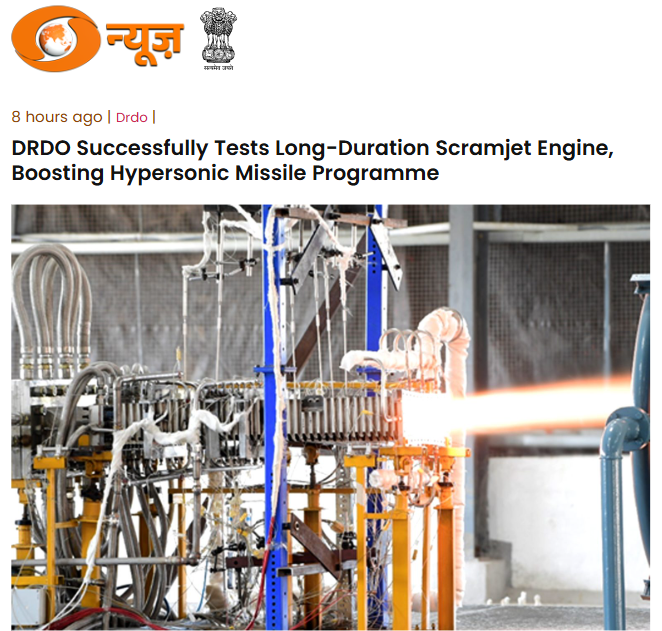
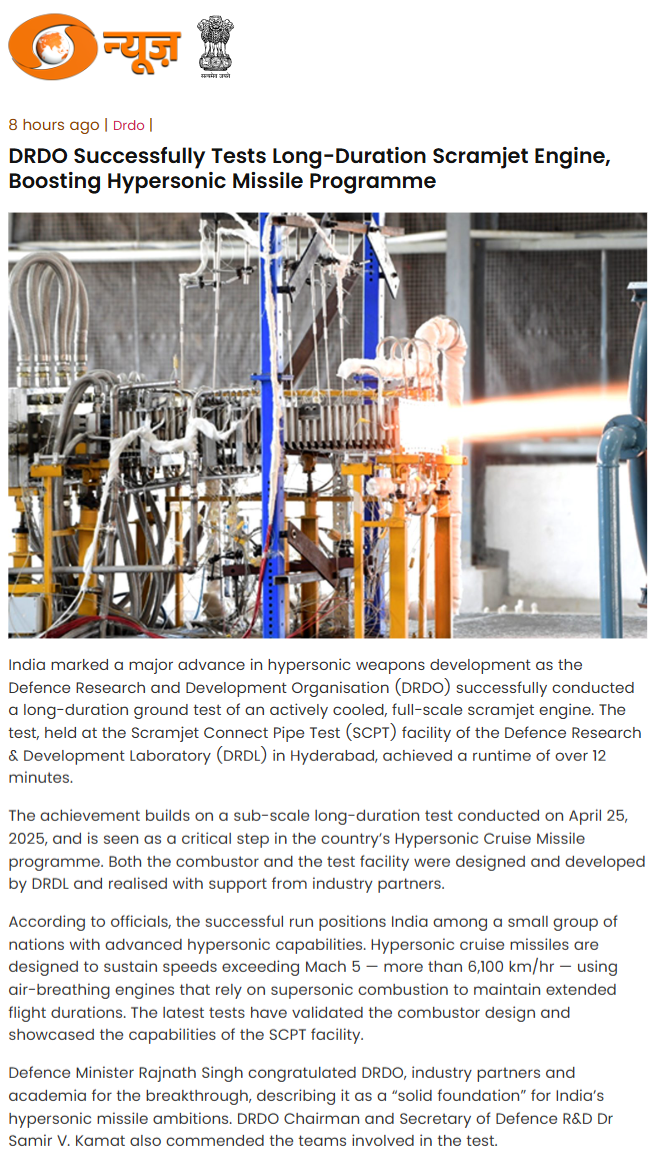
391. DRDO successfully tests long-duration scramjet engine, boosting hypersonic missile programme
- On January 10, 2026, DRDO successfully conducted a long-duration ground test of a full-scale, actively cooled scramjet engine at the SCPT facility in Hyderabad, achieving a runtime of over 12 minutes — a major milestone in India’s hypersonic weapons programme.
- The test builds on an earlier sub-scale run in April 2025 and validates the combustor design and test infrastructure, placing India among a small group of countries with advanced hypersonic technology capable of sustaining speeds above Mach 5.
- Defence Minister Rajnath Singh and DRDO leadership praised the achievement as a critical foundation for India’s hypersonic cruise missile development, highlighting the role of DRDO, industry and academia in the breakthrough.
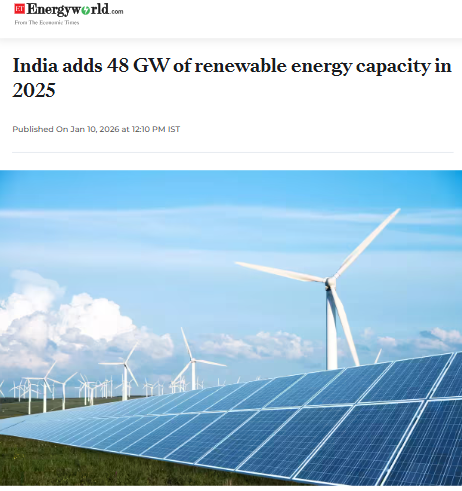
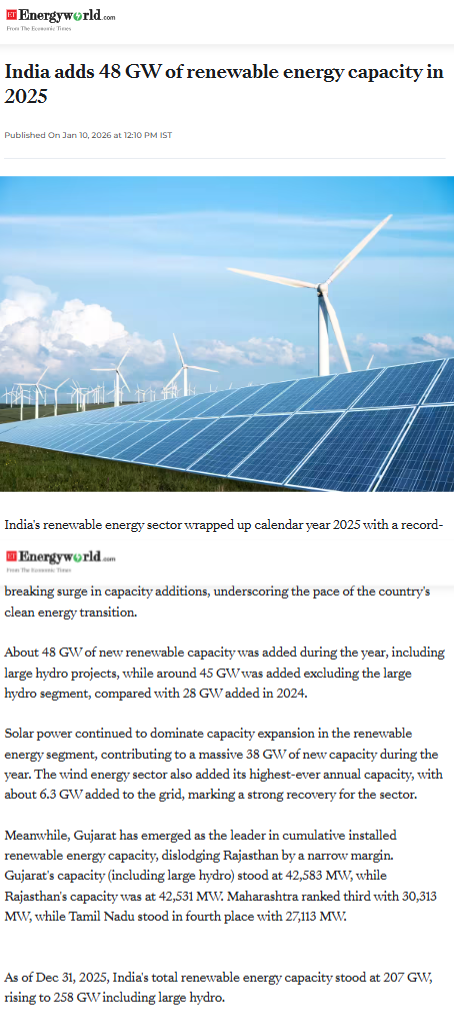
392. India adds 48 GW of renewable energy capacity in 2025
- On January 10, 2026 It was reported that, In calendar year 2025, India added about 48 GW of renewable energy capacity nationwide (45 GW excluding large hydro), sharply higher than 28 GW in 2024, marking the fastest annual growth in the country’s renewable sector.
- India’s clean energy expansion was driven mainly by solar power additions of 38 GW and a wind sector recovery adding 6.3 GW, supported by large-scale projects and policy-led momentum across multiple states.
- By December 31, 2025, India’s renewable capacity reached 207 GW (258 GW including large hydro), with Gujarat leading installed capacity at 42,583 MW, narrowly ahead of Rajasthan, followed by Maharashtra and Tamil Nadu.
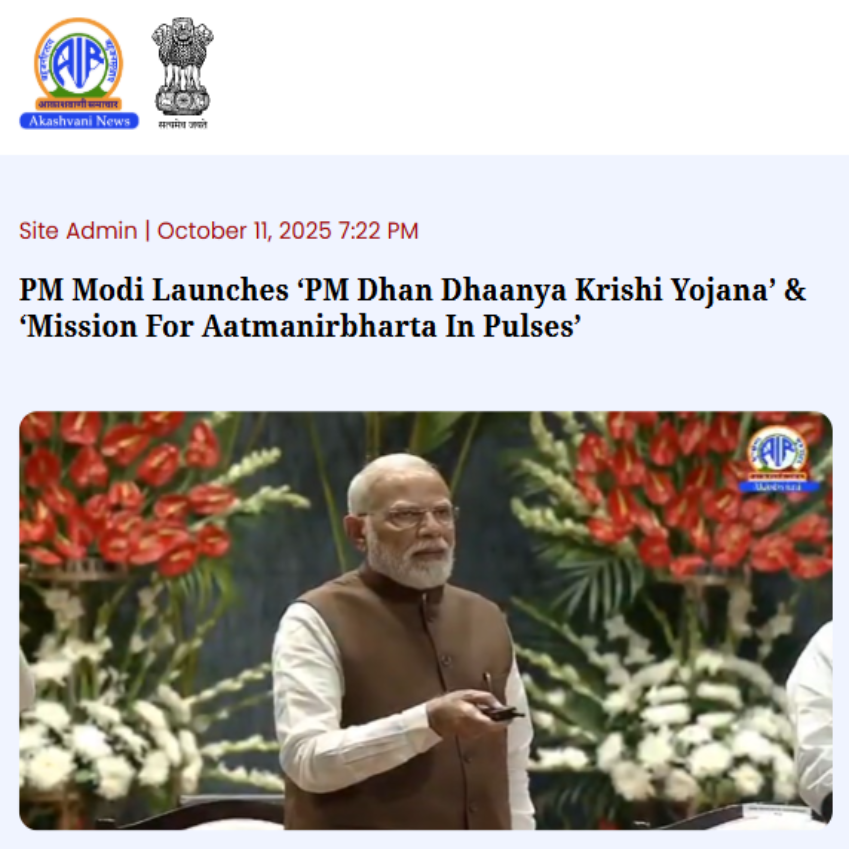

393. PM Launches ‘PM Dhan Dhaanya Krishi Yojana’ & ‘Mission for Aatmanirbharta in Pulses’
- Prime Minister on 11 October 2025, launched, inaugurated and laid the foundation stone of multiple projects and schemes worth over 42 thousand crore rupees in the agriculture and allied sectors at a special Krishi programme in New Delhi.
- Prime Minister unveiled two major initiatives in the agriculture sector, ‘PM Dhan Dhaanya Krishi Yojana’ and ‘Mission for Aatmanirbharta in Pulses with an outlay of more than 35 thousand crore rupees.
- PM Dhan Dhaanya Krishi Yojana has been launched with an outlay of 24 thousand crore rupees with the objective of enhancing agricultural productivity. Increasing adoption of crop diversification and sustainable agriculture practices and improving irrigation facilities for long-term and short-term credit in the selected 100 districts.
- While the Mission for Aatmanirbharta in Pulses have been launched with an outlay of 11 thousand 440 crore. It is aimed at improving productivity levels of pulses, expanding the area under pulse cultivation, strengthening the value chain, procurement, storage, processing, and ensuring reduction of losses.
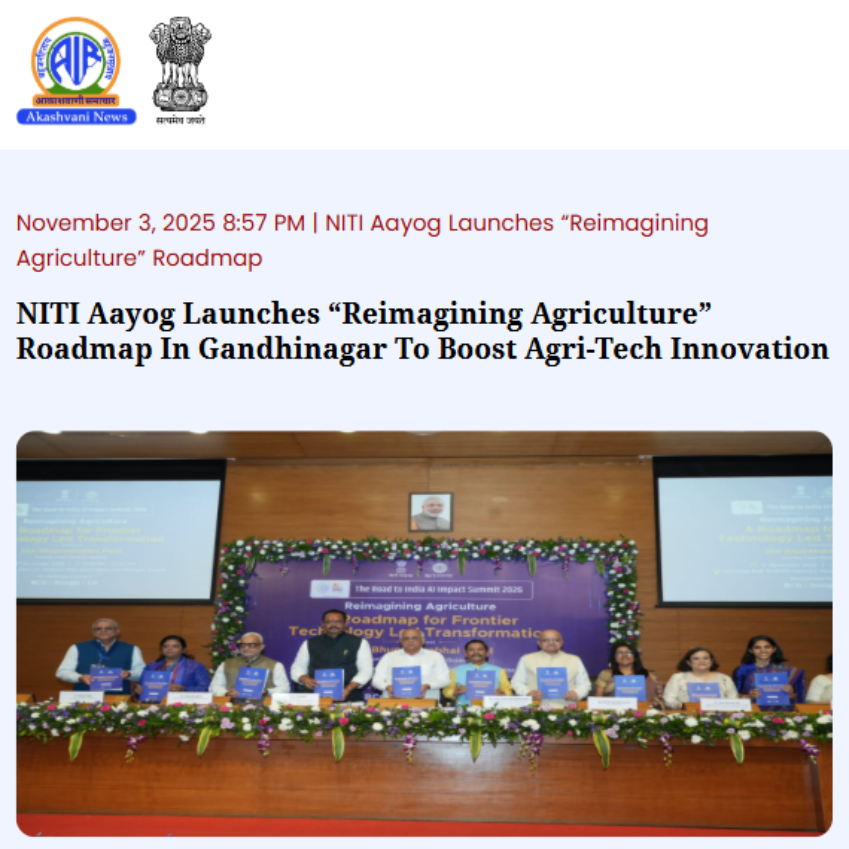
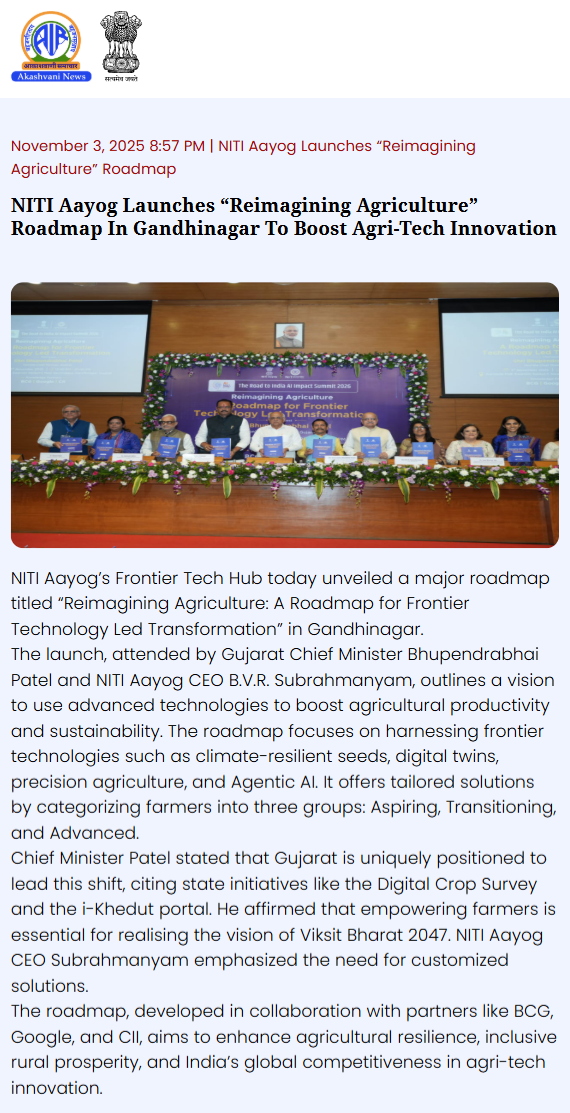
394. NITI Aayog Launches “Reimagining Agriculture” Roadmap in Gandhinagar to Boost Agri-Tech Innovation
- NITI Aayog’s Frontier Tech Hub today unveiled a major roadmap titled “Reimagining Agriculture: A Roadmap for Frontier Technology Led Transformation” in Gandhinagar.
- The roadmap focuses on harnessing frontier technologies such as climate-resilient seeds, digital twins, precision agriculture, and Agentic AI. It offers tailored solutions by categorizing farmers into three groups: Aspiring, Transitioning, and Advanced.
- The roadmap, developed in collaboration with partners like BCG, Google, and CII, aims to enhance agricultural resilience, inclusive rural prosperity, and India’s global competitiveness in agri-tech innovation.
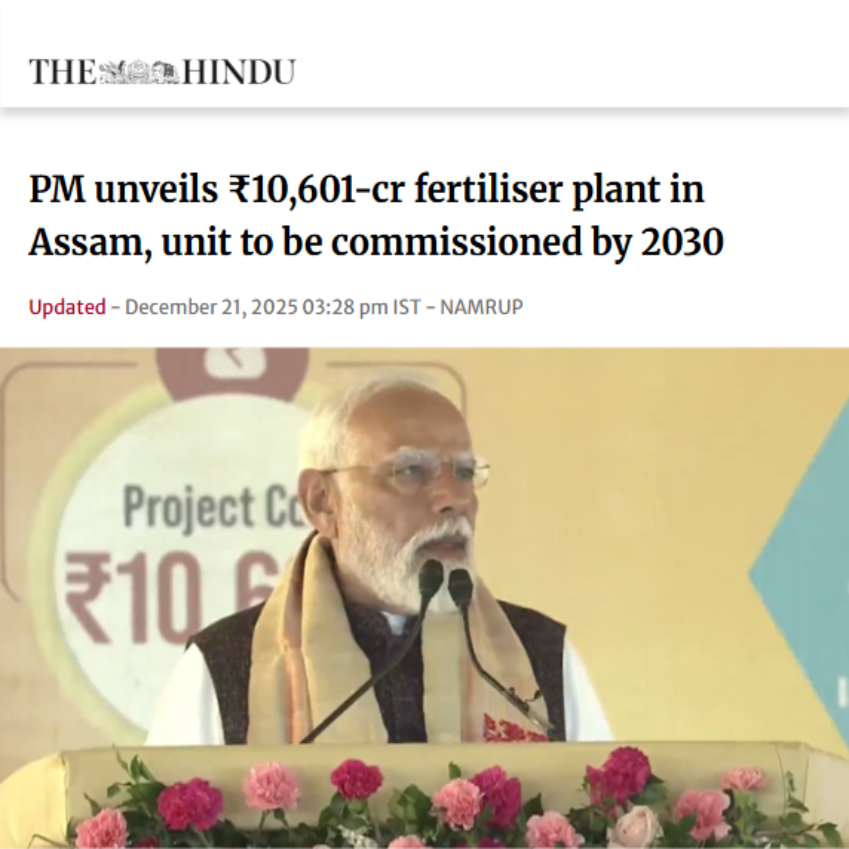
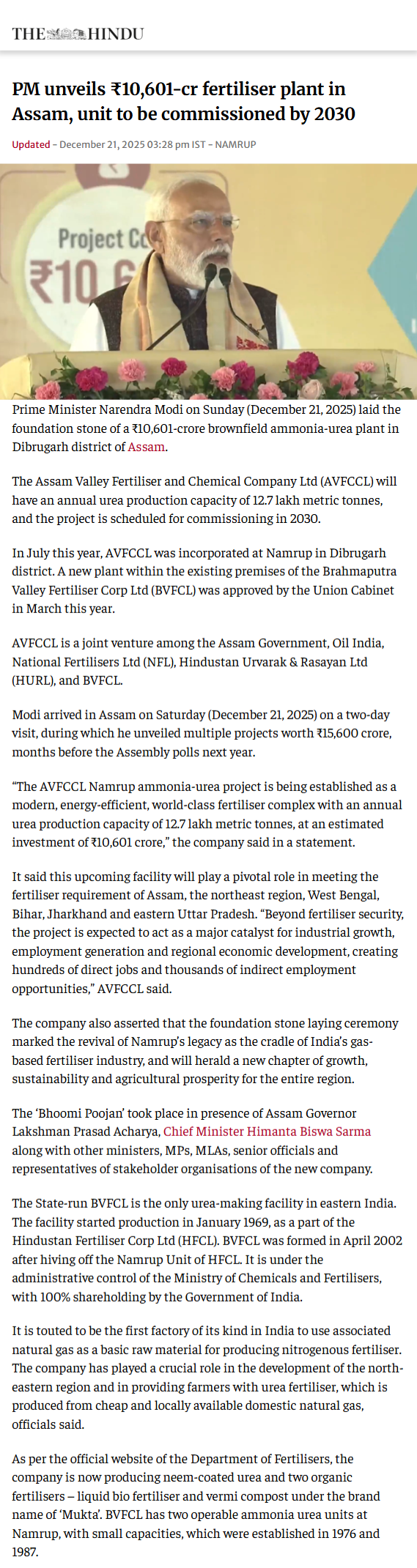
395. PM unveils ₹10,601-cr fertiliser plant in Assam, unit to be commissioned by 2030
- Prime Minister on December 21, 2025 laid the foundation stone of a ₹10,601-crore brownfield ammonia-urea plant in Dibrugarh district of Assam.
- The Assam Valley Fertiliser and Chemical Company Ltd (AVFCCL) will have an annual urea production capacity of 12.7 lakh metric tonnes, and the project is scheduled for commissioning in 2030.
- In July this year 2025, AVFCCL was incorporated at Namrup in Dibrugarh district. A new plant within the existing premises of the Brahmaputra Valley Fertiliser Corp Ltd (BVFCL) was approved by the Union Cabinet in March this year 2025.
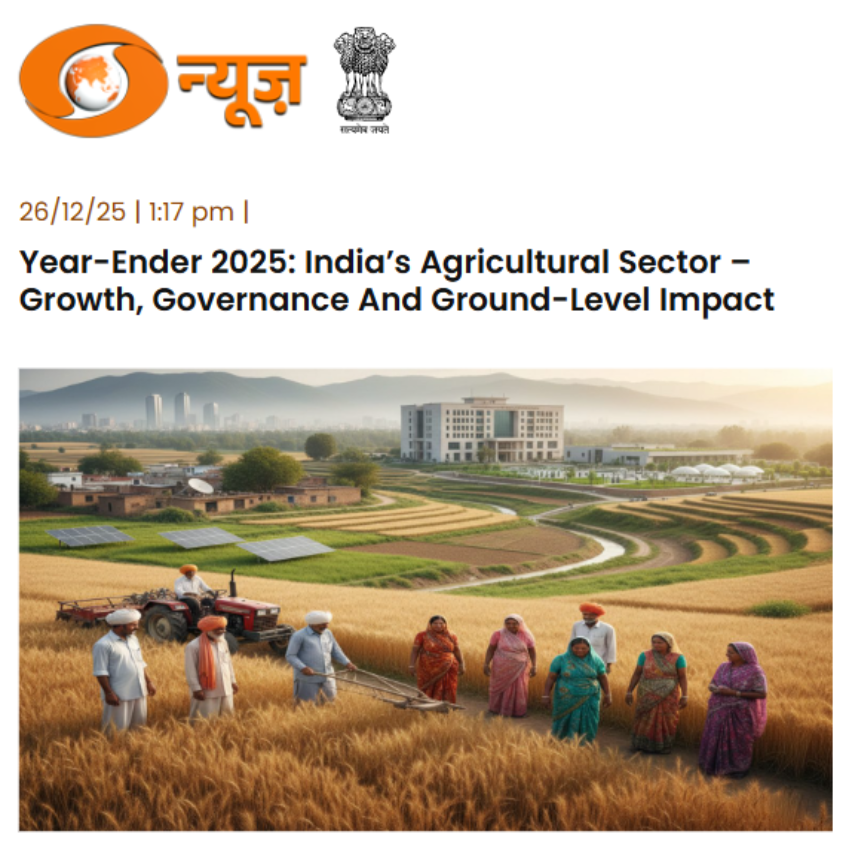

396. Year-ender 2025: India’s Agricultural sector – Growth, governance and ground-level impact
- The year 2025 marked a defining phase for India’s agricultural sector. Agriculture and allied activities continued to remain the backbone of the rural economy, contributing nearly 16 per cent to India’s Gross Domestic Product in FY 2024-25 and providing livelihoods to more than 46 per cent of the population.
- India recorded its highest-ever foodgrain production of 357.73 million tonnes in 2024-25, reflecting an increase of nearly eight per cent over the previous year and a historic rise of over 106 million tonnes compared to 2015–16. This growth was driven by record output of rice and wheat.
- Rice production reached 150.184 million tonnes, while wheat output stood at 117.945 million tonnes.
- Direct income support under PM-Kisan Samman Nidhi remained a cornerstone of farmer welfare. As of August 2025, ₹3.90 lakh crore had been transferred directly to farmers through 20 instalments, benefiting more than 11 crore farmers nationwide.
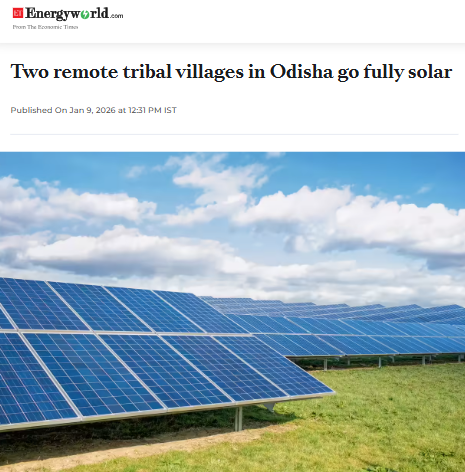
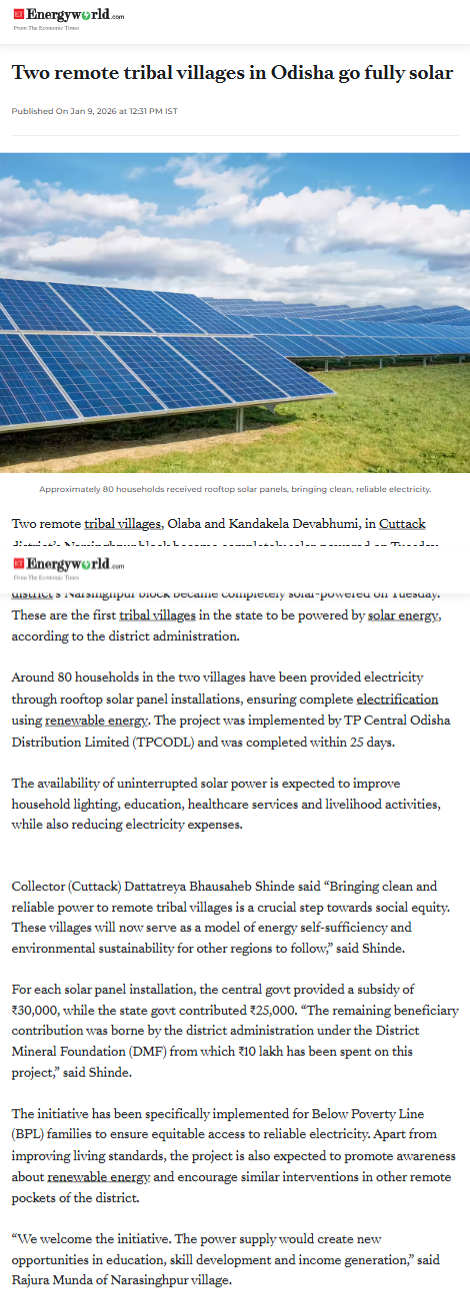
397. Two remote tribal villages in Odisha go fully solar
- On January 6 2026, Olaba and Kandakela Devabhumi villages in Narsinghpur block of Cuttack district, Odisha, became the state’s first fully solar-powered tribal villages, achieving complete electrification through renewable energy.
- The project was implemented by TP Central Odisha Distribution Limited, which installed rooftop solar panels in about 80 households within 25 days, ensuring uninterrupted power supply for Below Poverty Line tribal families.
- Each installation received ₹30,000 central and ₹25,000 state subsidy, with ₹10 lakh funded by the District Mineral Foundation. Officials said the project will boost education, healthcare, livelihoods, and serve as a sustainability model.
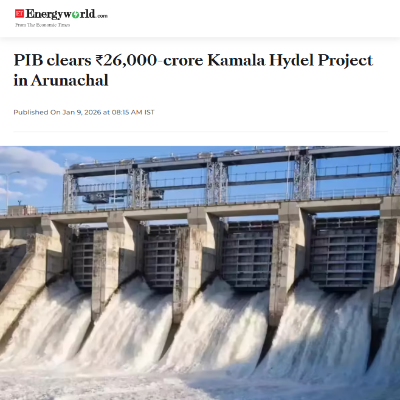
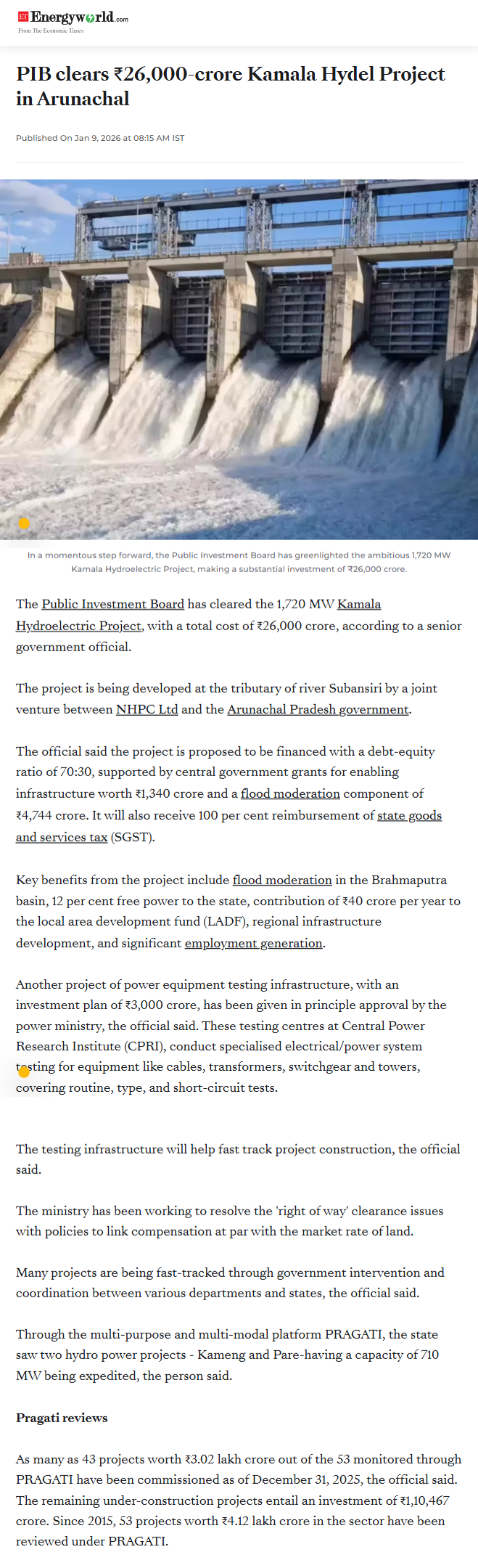
398. PIB clears ₹26,000-crore Kamala Hydel Project in Arunachal
- On January 9, 2026, the Public Investment Board approved the 1,720 MW Kamala Hydroelectric Project costing ₹26,000 crore, to be developed on a tributary of the Subansiri River in Arunachal Pradesh, according to a senior government official.
- The project will be developed by a joint venture of NHPC Ltd and the Arunachal Pradesh government, financed through a 70:30 debt-equity ratio, with central grants, SGST reimbursement, and dedicated funding for flood moderation and infrastructure.
- Benefits include flood control in the Brahmaputra basin, 12% free power to the state, ₹40 crore annually for LADF, jobs, and infrastructure growth; additionally, a ₹3,000 crore power equipment testing project received in-principle approval.
Click here to find 759 similar incidents of North East India -> Infrastructure Development
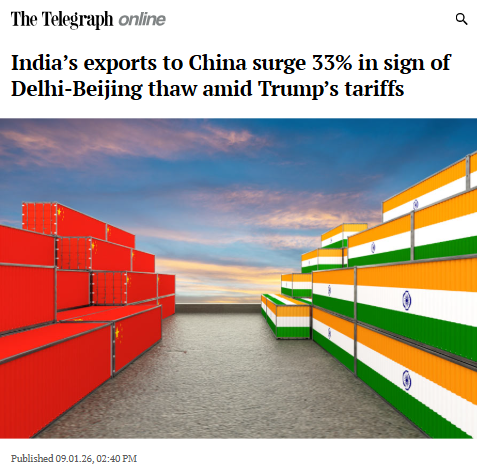
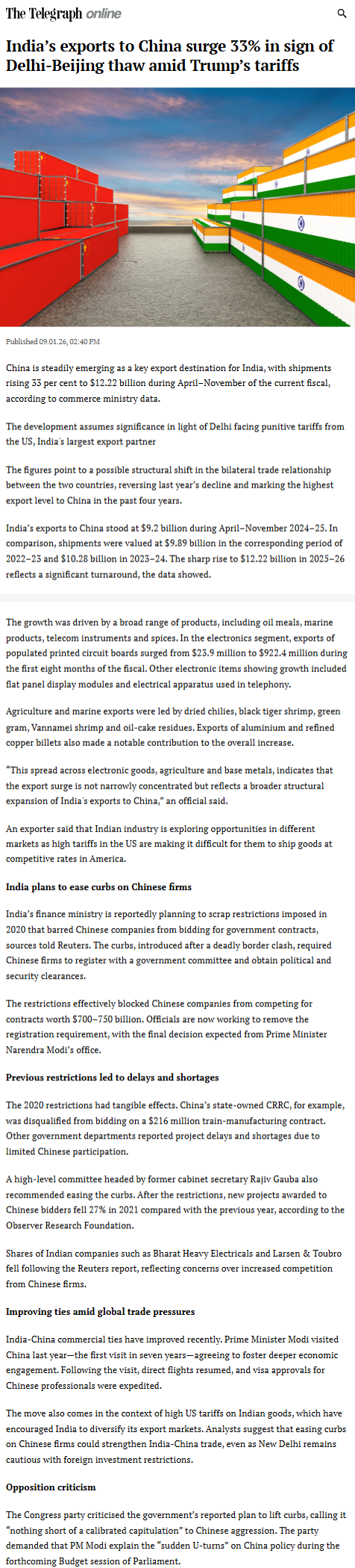
399. India’s exports to China surge 33% in sign of Delhi-Beijing thaw amid Trump’s tariffs
- On 9 January 2026, It was reported that, During April–November of the current fiscal, India’s exports to China rose 33% to $12.22 billion, marking the highest level in four years and reversing last year’s decline, according to commerce ministry data.
- Indian exporters boosted shipments across electronics, agriculture, marine products, and metals, driven partly by diversification as punitive US tariffs reduced competitiveness in America, prompting industry to seek alternative markets like China.
- Electronics exports, especially printed circuit boards, surged sharply; agriculture and metals also contributed. India is considering easing 2020 curbs on Chinese firms, improving trade ties, though the move has drawn political criticism and market concerns.
Click here to find 860 similar incidents of Bharat Economic Growth -> Increasing Exports
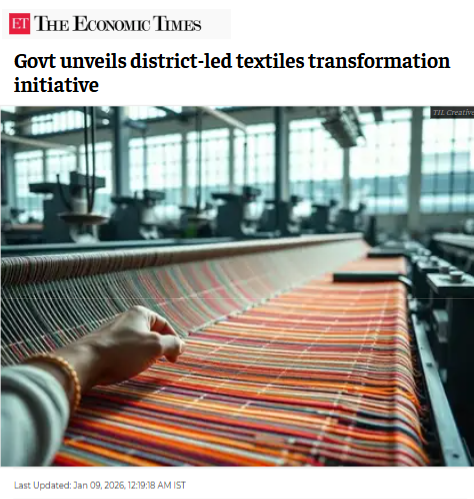
400. Govt unveils district-led textiles transformation initiative
- On 8 January 2026 in New Delhi, the Textiles Ministry unveiled the DLTT initiative to transform 100 districts into Global Export Champions and uplift 100 Aspirational Districts as self-reliant textile hubs.
- The Textiles Ministry used a data-driven scoring model based on export performance, MSME ecosystem, and workforce presence, categorizing districts into Champion and Aspirational groups with tailored development strategies.
- Champion Districts will address advanced bottlenecks using Industry 4.0 and export linkages, while Aspirational Districts will focus on skilling, raw material banks, SHGs, and cooperatives, with special emphasis on Purvodaya regions in east and northeast India.
Click here to find 77 similar incidents of Make in India / Atmanirbhar -> Textiles and Garments