 Loading...
| Jan 01, 1970 | Daily Report |
| RISING BHARAT | News Count (102601) | |
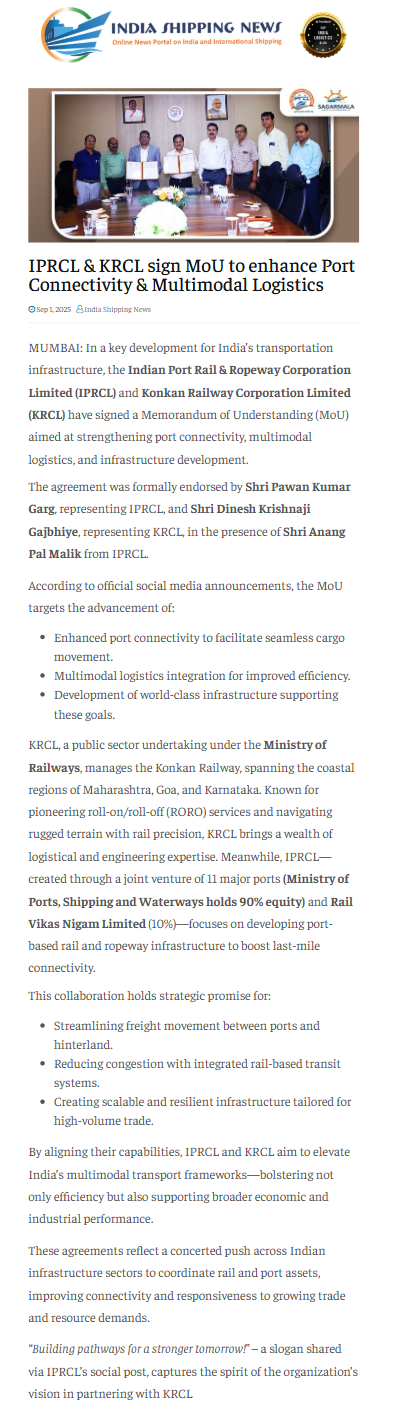
1241. IPRCL & KRCL sign MoU to enhance Port Connectivity & Multimodal Logistics Sep 1, 2025 India Shipping News
- On 1 September 2025, It was reported that, IPRCL and KRCL signed an MoU to enhance port connectivity, multimodal logistics, and infrastructure development across India, particularly targeting coastal regions of Maharashtra, Goa, and Karnataka.
- The collaboration aims to streamline freight movement, integrate rail-based transit systems, and reduce congestion, leveraging KRCL’s rail expertise and IPRCL’s port-based infrastructure capabilities for efficient and seamless cargo transportation.
- The partnership will create scalable, resilient multimodal infrastructure, boosting trade efficiency, industrial growth, and India’s overall economic performance, while strengthening last-mile connectivity between ports and the hinterland.
1242. India’s pharma sector posts 11% growth in Q1 FY26, outpacing GDP
- On 1 September 2025, It was Reported that, In Q1 FY26, India’s pharmaceutical sector delivered ~11% growth in revenue and EBITDA, outperforming the country’s 7.8% GDP growth, driven by hospitals, diagnostics, and pharmaceutical exports, highlighting the sector’s robust domestic and global performance.
- The growth is powered by generic drugs, APIs, and biosimilars, with Indian companies leveraging manufacturing scale, innovation, and quality to serve global markets, particularly the US, EU, Africa, and China, making exports central to sector performance.
- India holds over 40% of the global generic market and 90% of HIV and oncology drug supply, with pharma exports projected to reach USD 50 billion by FY2030, reinforcing India’s position as a global healthcare and pharmaceutical powerhouse.
Click here to find 862 similar incidents of Bharat Economic Growth -> Increasing Exports
1243. Govt launches advanced biomanufacturing hubs to boost bioeconomy, innovation
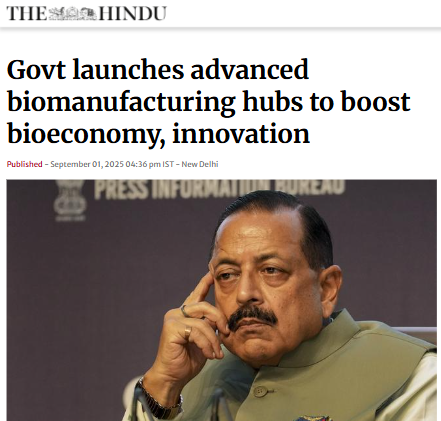
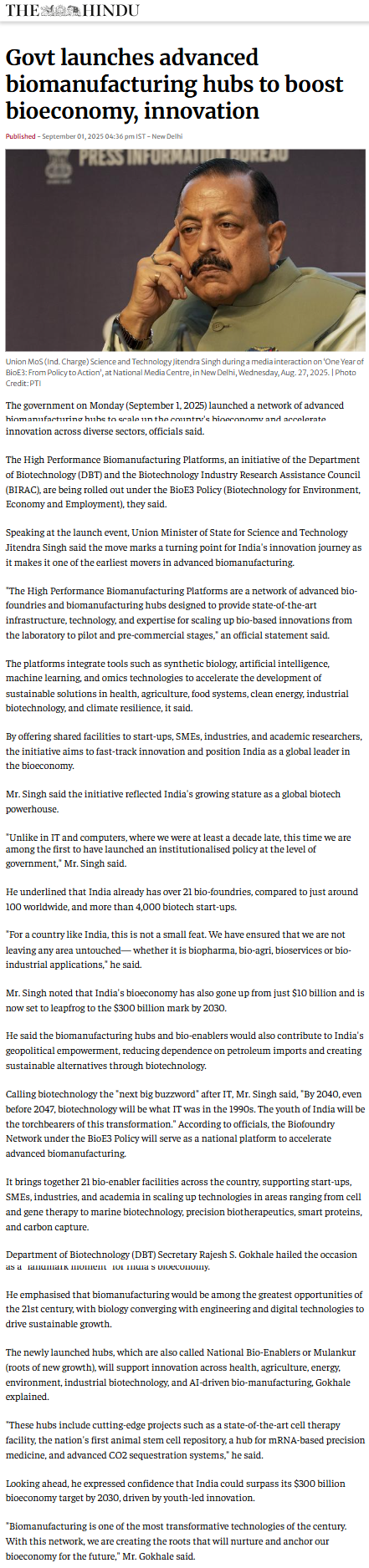
- On September 1, 2025, India launched a network of High Performance Biomanufacturing Platforms under the BioE3 Policy, providing advanced bio-foundries and hubs nationwide to scale innovations from laboratory to pre-commercial stages across health, agriculture, energy, and industrial biotechnology.
- The initiative aims to accelerate India’s bioeconomy and innovation by integrating synthetic biology, AI, machine learning, and omics technologies. Shared facilities will support start-ups, SMEs, industries, and academia, reducing dependence on imports and fostering sustainable, bio-based solutions.
- India now has 21 bio-enabler hubs, contributing to a bioeconomy projected to grow from $10 billion to $300 billion by 2030. Key facilities include cell therapy labs, animal stem cell repositories, mRNA hubs, and CO₂ sequestration systems, positioning India as a global biotech leader.
1244. UPI crosses 20 billion monthly transactions for first time in August; value hits ₹24.85 lakh crore
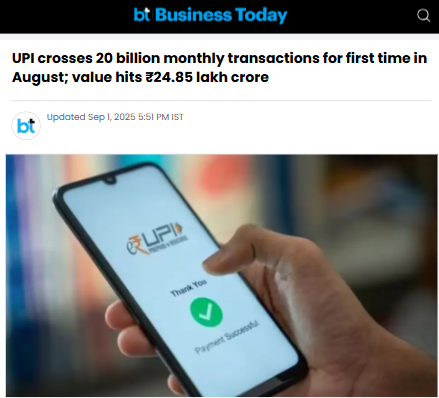
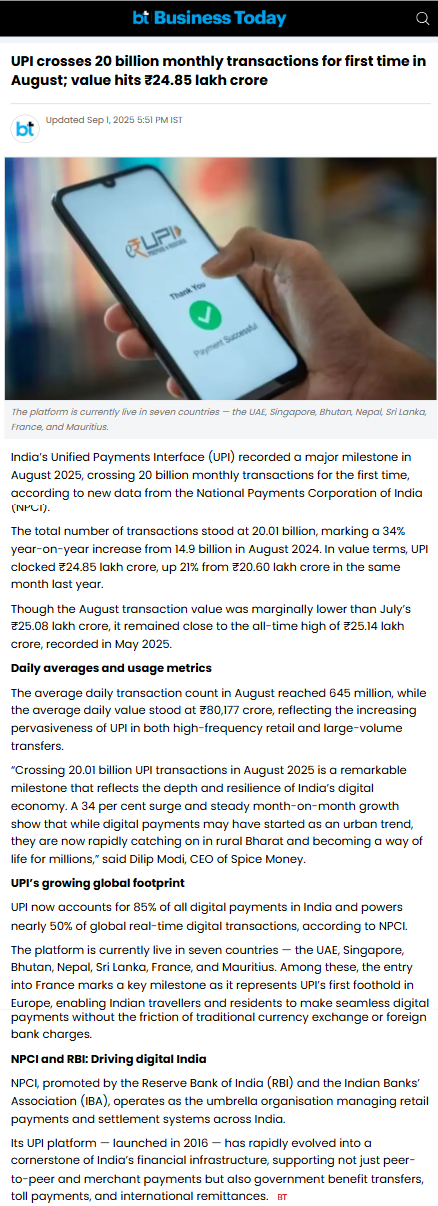
- On 1 September 2025 it was reported that, In August 2025, India’s Unified Payments Interface (UPI) crossed 20 billion monthly transactions, totaling ₹24.85 lakh crore, marking a 34% year-on-year increase. Average daily transactions reached 645 million, showing UPI’s widespread adoption across urban and rural India.
- Growth was driven by high-frequency retail and large-value transfers, reflecting UPI’s deep penetration. Daily transaction value averaged ₹80,177 crore. The system’s seamless, real-time digital payments and adoption in multiple sectors, including government transfers, fueled this milestone.
- UPI now accounts for 85% of India’s digital payments and nearly 50% of global real-time transactions. With availability in seven countries, including France as its first European market, UPI underscores India’s expanding digital economy and global fintech influence.
Click here to find 173 similar incidents of Bharat Economic Growth -> Digital Economy
1245. Manufacturing PMI rises to 17-year high of 59.3 in August 2025
- On 1 September it was reported that, In August 2025, India’s manufacturing sector expanded at the fastest rate in over 17 years, with the HSBC Manufacturing PMI rising to 59.3, reflecting the strongest improvement since 2008, driven by increased factory orders and production across the country.
- Growth was fueled by higher domestic demand, new orders, and production increases, with companies buying more materials and creating jobs. Advertising success and positive business expectations contributed, though export orders slowed due to the U.S. raising tariffs on Indian goods to 50%.
- Production volumes grew fastest in nearly five years, and new orders rose at the quickest pace in 57 months. The data reflects robust manufacturing recovery, strong domestic demand, and India’s improving competitiveness in global supply chains despite tariff-related challenges.
Click here to find 1469 similar incidents of Bharat Economic Growth -> Bharat Economic Growth
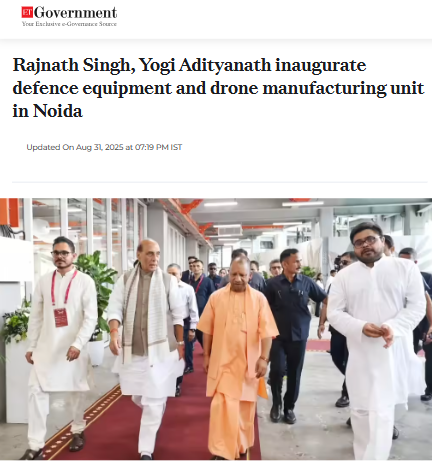

1246. Rajnath Singh, Yogi Adityanath inaugurate defence equipment and drone manufacturing unit in Noida
- On, 30 August 2025, Defence Minister and UP Chief Minister inaugurated Raphe mPhibr Pvt. Ltd.’s defence equipment and drone manufacturing unit, aircraft engine facility, and India’s largest aero engine test bed in Gautam Buddh Nagar, Uttar Pradesh, marking a milestone for self-reliant defence production.
- The unit focuses on domestic drone technology, aircraft engines, and advanced defence systems, addressing modern warfare needs exemplified by the Russia-Ukraine conflict. With over 600 scientists and engineers, Raphe mPhibr developed three defence products in 14 months deployed in Operation Sindoor, promoting indigenous innovation and Atmanirbhar Bharat in defence manufacturing.
- Founded in 2017 by Vishal Mishra and Vivek Mishra, Raphe mPhibr has scaled rapidly, creating 5,000+ expected jobs in Uttar Pradesh. The facility represents India’s new technological revolution in defence, enhancing national security, technological self-reliance, and global competitiveness in drones, aerospace, and strategic defence systems.

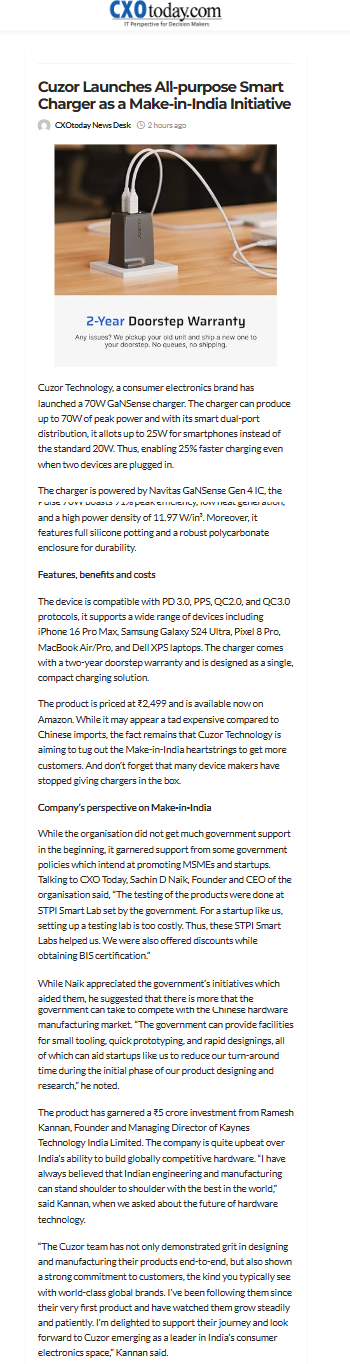
1247. Cuzor Launches All-purpose Smart Charger as a Make-in-India Initiative
- On 1 September 2025, it was reported that Cuzor Technology launched the 70W GaNSense Pulse charger in India, offering dual-port charging with up to 25W for smartphones. The product is available on Amazon for ₹2,499 and aims to cater to Make-in-India conscious consumers seeking a compact, efficient charging solution.
- Powered by Navitas GaNSense Gen 4 IC, the charger achieves 91% peak efficiency, low heat, and high power density. Supporting PD 3.0, PPS, QC2.0, and QC3.0 protocols, it enables 25% faster charging even when two devices are connected, and is compatible with popular smartphones and laptops including iPhone 16 Pro Max and MacBook Pro.
- The product reflects India’s growing hardware ecosystem, aided by government initiatives like STPI Smart Labs for testing and BIS certification.
Click here to find 275 similar incidents of Make in India / Atmanirbhar -> Electronic Systems
1248. Soil Health Boost: Soil Health Card Scheme
- Prime Minister has launched nationwide Soil Health Card (SHC) scheme in Suratgarh town of Sri ganganagar district, Rajasthan. During the launch PM gave slogan- Swasth Dharaa. Khet Haraa (Healthy Earth, Green Farm).
- SHC is centrally-sponsored nationwide scheme which aims to help farmers to improve the productivity of farms by providing them basic information for use of nutrients or fertilizers.
- The card carries crop-wise recommendation of fertilisers that are required for farm lands. It also helps farmers identify health of soil and judiciously use soil nutrients. Under this scheme Centre plans to target over 14 crore farmers in the next three years. In financial year 2014-15, around 3 crore farmers will be covered to check the excess use of fertilisers.
- In the budget, government had allotted Rs. 100 crore for issuing cards under the scheme. Government also had allotted additional Rs. 56 crore to set up 100 mobile soil testing laboratories across India.
1249. Paramparagat Krishi Vikas Yojana
- The Paramparagat Krishi Vikas Yojana (PKVY), launched in 2015, is an extended component of Soil Health Management (SHM) under the Centrally Sponsored Scheme (CSS), National Mission on Sustainable Agriculture (NMSA). PKVY aims at supporting and promoting organic farming, in turn resulting in improvement of soil health.
- Funding pattern under the scheme is in the ratio of 60:40 by the Central and State Governments respectively. In case of North Eastern and Himalayan States, Central Assistance is provided in the ratio of 90:10 (Centre: State) and for Union Territories, the assistance is 100%.
- The Scheme targets to form 10,000 clusters of 20 ha each and bring nearly two lakh hectares of agricultural area under organic farming by 2017-18. The objective is to produce agricultural products free from chemicals and pesticides residues by adopting eco- friendly, low- cost technologies.
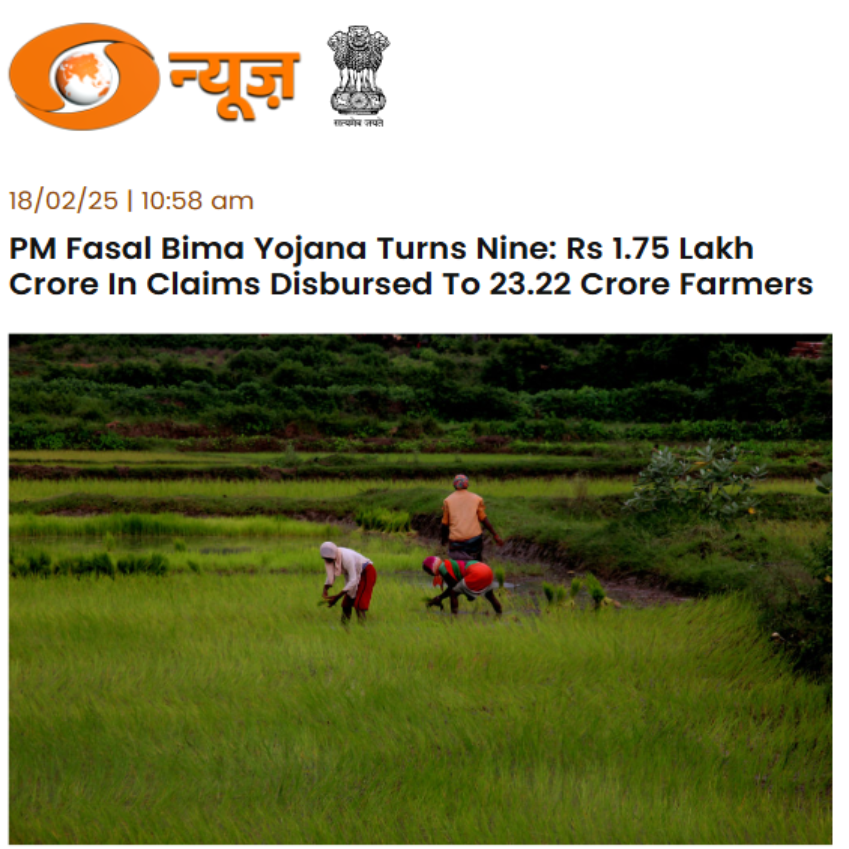
1250. PM Fasal Bima Yojana turns nine: Rs 1.75 lakh crore in claims disbursed to 23.22 crore farmers
- The Pradhan Mantri Fasal Bima Yojana (PMFBY), a scheme providing comprehensive coverage for farmers against crop losses caused by unpredictable natural disasters, has disbursed Rs 1.75 lakh crore in claims to more than 23.22 crore farmers over the past nine years.
- The scheme witnessed a 25% growth in farmer enrolment in 2023-24 compared to the previous year, demonstrating its growing popularity.
- The Union Cabinet, recognizing PMFBY’s impact, approved its continuation along with the Restructured Weather Based Crop Insurance Scheme (RWBCIS) till 2025-26, with a budget of Rs.69,515.71 crore. RWBCIS, introduced alongside PMFBY, is a weather index-based scheme that complements PMFBY’s crop insurance approach.
- The scheme witnessed a 25% growth in farmer enrolment in 2023-24 compared to the previous year, demonstrating its growing popularity.