 Loading...
| Jan 01, 1970 | Daily Report |
| RISING BHARAT | News Count (102145) | |
1061. Tripura’s Sarkhipara Village Lights Up with Solar Power After Years in Darkness
- After being in the gloom for last 80 years, an outlying tribal hamlet of Sarkhipara in Tripura’s Khowai District has undergone radical transformation and now been illuminated with solar power.
- A senior official noted that in September 2021, a 2-KW microgrid power plant each was installed at Sarkhipara and 11 other remote hamlets of Tripura for the purpose of supplying electricity to villages.
- Prime Minister officially inaugurated the project in a virtual programme on July 30, 2022. Children now study under electric lamps, while men make bamboo-based traditional handicrafts and women weave tribal attires under the cool breeze of ceiling fans.
Click here to find 816 similar incidents of Focus on States -> North East India
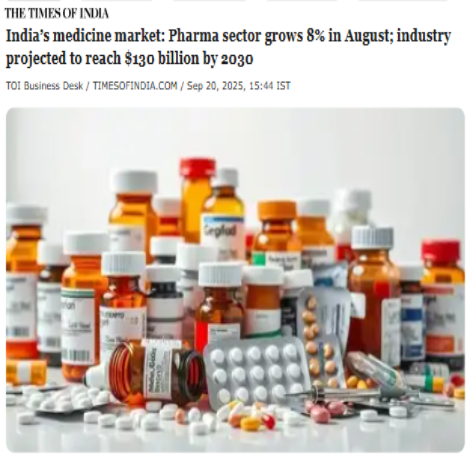
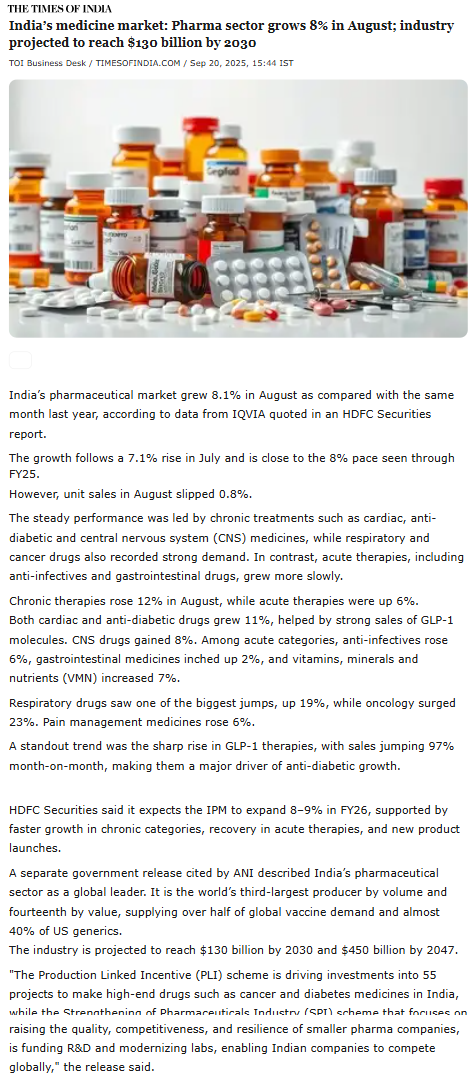
1062. India’s medicine market: Pharma sector grows 8% in August; industry projected to reach $130 billion by 2030
- On 20 september, 2025, It was reported that, In August 2025, India’s pharmaceutical market grew 8.1% year-on-year, following 7.1% growth in July, according to IQVIA data cited by HDFC Securities. Chronic therapies led the expansion, though overall unit sales slipped 0.8% during the month.
- Chronic drugs like cardiac, anti-diabetic (GLP-1 up 97%), and CNS grew strongly, alongside respiratory (+19%) and oncology (+23%). Acute therapies rose modestly, led by anti-infectives (+6%), gastrointestinal (+2%), VMN (+7%), and pain management (+6%). Growth was driven by rising chronic demand and innovation.
- India, the world’s third-largest pharma producer by volume, supplies half of global vaccines and 40% of US generics. With support from PLI and SPI schemes, the sector is projected to reach $130 billion by 2030 and $450 billion by 2047.
Click here to find 1469 similar incidents of Bharat Economic Growth -> Bharat Economic Growth
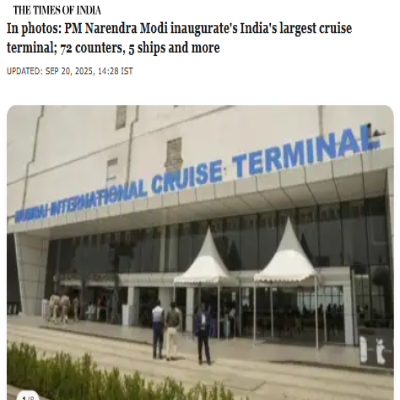

1063. PM Narendra Modi inaugurate's India's largest cruise terminal; 72 counters, 5 ships and more
- On September 20, 2025, Prime Minister inaugurated the Mumbai International Cruise Terminal at Indira Dock. Built under the Cruise Bharat Mission, the ₹556 crore project marks India’s largest international cruise terminal for tourism and maritime growth.
- PM launched MICT, designed with modern architecture, rose-gold interiors, heritage plaques, and cultural elements. The terminal supports one million passengers yearly, with 72 immigration and check-in counters ensuring smooth operations and secure, world-class cruise tourism facilities.
- Spread across 4,15,000 sq ft with 2,07,000 sq ft passenger area, MICT accommodates five ships simultaneously. It aims to position India as a global cruise hub by offering ocean, river, and island cruise experiences under the Cruise Bharat Mission.
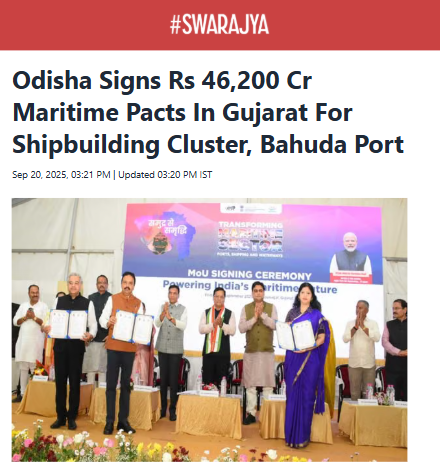
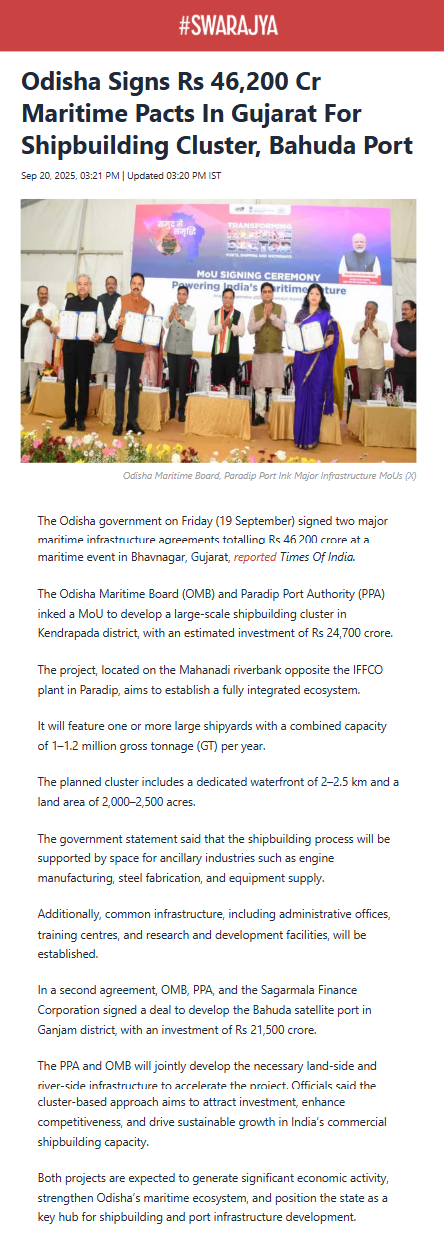
1064. Odisha Signs Rs 46,200 Cr Maritime Pacts In Gujarat For Shipbuilding Cluster, Bahuda Port
- On September 19, 2025, the Odisha government signed two MoUs at Bhavnagar, Gujarat, worth ₹46,200 crore to develop a shipbuilding cluster in Kendrapada and a satellite port project at Bahuda in Ganjam district.
- Odisha Maritime Board, Paradip Port Authority, and Sagarmala Finance Corporation will jointly develop land-side and river-side infrastructure, aiming to establish integrated shipbuilding and port facilities through large shipyards, ancillary industries, and financing support for sustainable maritime growth.
- The Kendrapada cluster will cost ₹24,700 crore, span 2,000–2,500 acres, and target 1–1.2 million GT annually with 2–2.5 km waterfront. The Bahuda port project, worth ₹21,500 crore, will enhance competitiveness, attract investments, and expand India’s shipbuilding capacity.
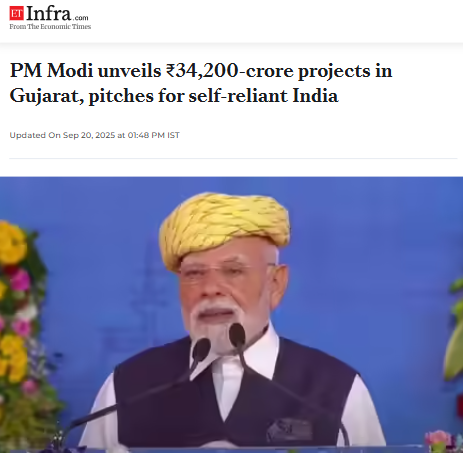

1065. PM Modi unveils ₹34,200-crore projects in Gujarat, pitches for self-reliant India
- On September 20, 2025, Prime Minister of India inaugurated and laid foundation stones for projects worth ₹34,200 crore during the Samudra Se Samriddhi programme at Jawahar Maidan, Bhavnagar, with a major focus on the maritime sector.
- PM , addressing a large gathering, highlighted Atmanirbhar Bharat, cruise tourism, and service initiatives like Sewa Pakhwada. He launched port modernisation, inland waterways, and international cruise terminal projects to strengthen India’s maritime and economic growth.
- Key developments include ₹26,354 crore projects in Gujarat, such as HPLNG Regasification Terminal, PM-KUSUM solar feeder, Dhordo solar village, hospital expansions, roadways, and Dholera Special Investment Region. Maritime projects span Mumbai, Kolkata, Paradip, Ennore, Chennai, Car Nicobar, Patna, and Varanasi.
1066. SDHI inks ₹4,250 crore MoU with Gujarat Maritime Board to boost shipbuilding sector
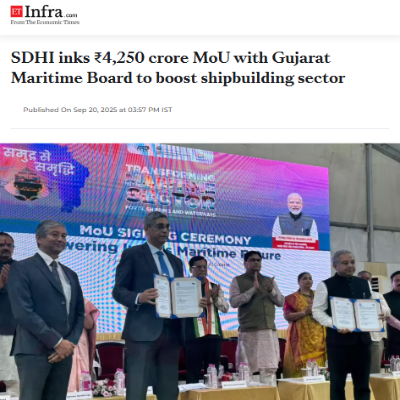
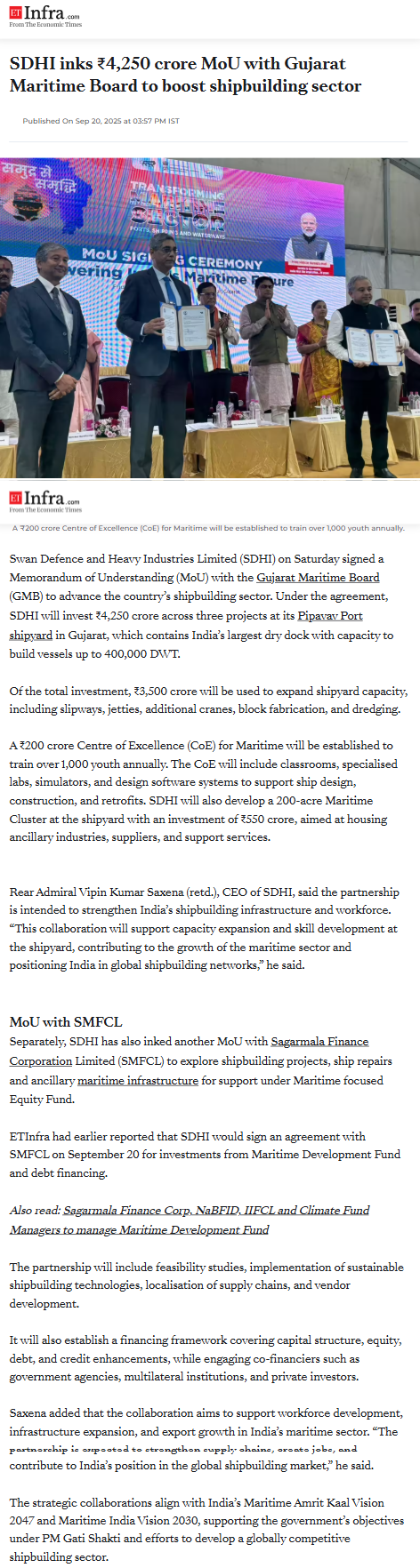
- On September 20, 2025, Swan Defence and Heavy Industries Limited (SDHI) signed an MoU with Gujarat Maritime Board to invest ₹4,250 crore in shipbuilding projects at its Pipavav Port shipyard, Gujarat.
- Rear Admiral Vipin Kumar Saxena (retd.), CEO of SDHI, announced collaborations with GMB and Sagarmala Finance Corporation to expand shipyard capacity, develop skills, and support maritime infrastructure through investments, training, and technology adoption.
- Investment includes ₹3,500 crore for shipyard expansion, ₹200 crore for a Maritime Centre of Excellence training 1,000 youth annually, and ₹550 crore for a 200-acre Maritime Cluster. Projects align with Maritime India Vision 2030 and Amrit Kaal Vision 2047.
1067. Doordarshan Launches New Channel ‘DD Retro’ To Telecast All Classic Hit Shows As Its Viewership Tops Charts
- On Apr 12, 2020 Prasar Bharti launched DD Retro, a channel dedicated to old classic Doordarshan shows, following the successful re-telecast of Ramayana and Mahabharat, aiming to reach viewers across India.
- State-owned broadcaster Prasar Bharti announced DD Retro via Twitter, leveraging nostalgia and high viewership of epic re-telecasts, with mandatory carriage on all DTH and cable networks as per government decree.
- Viewership of Ramayana at 9 AM and 9 PM grew 60 times, while Mahabharat at 12 PM and 7 PM surged 208 times, making Doordarshan India’s most-watched channel in Hindi markets, demonstrating strong audience demand for classic content.
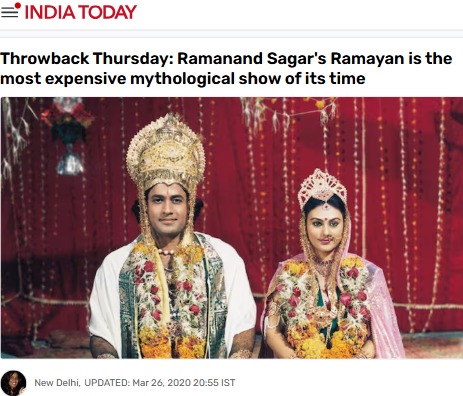
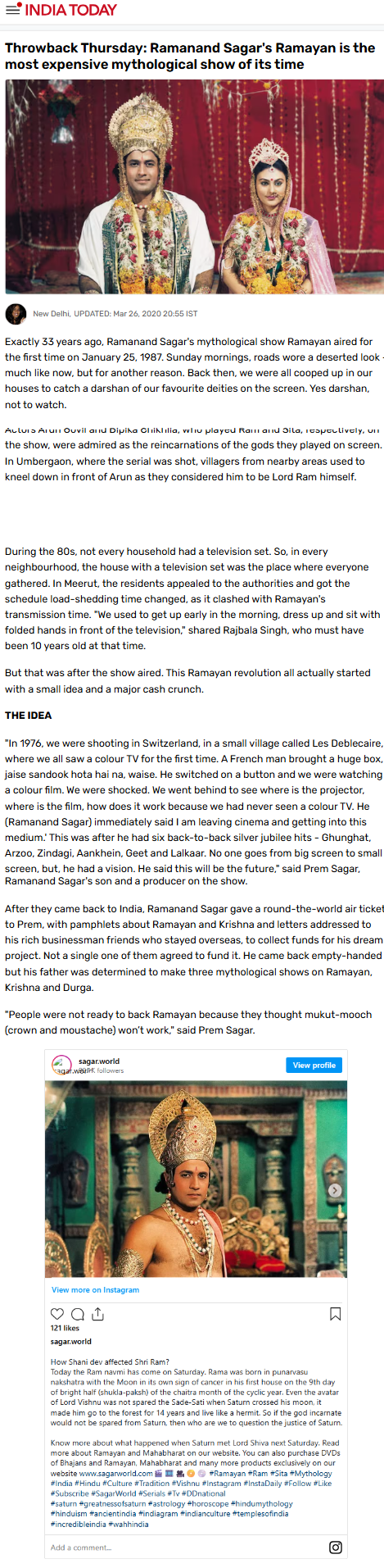
1068. Throwback Thursday: Ramanand Sagar's Ramayan is the most expensive mythological show of its time
- On January 25, 1987, Ramanand Sagar’s mythological TV show Ramayan premiered on Doordarshan, capturing nationwide attention as viewers across India gathered in homes and neighborhoods to watch the epic unfold.
- Ramanand Sagar, inspired by a colour TV in Switzerland, and his son Prem Sagar produced Ramayan, securing funds through sponsors after their prior success with Vikram Aur Betaal, creatively adapting the epic for 1980s Indian audiences.
- The show’s tweaks, like Ram’s gurukul days and Bharat refusing the crown, resonated widely. First telecast viewership reached 40 million, generating Rs 23 crore revenue, later broadcast in 53 countries, and ultimately viewed by over 650 million globally.
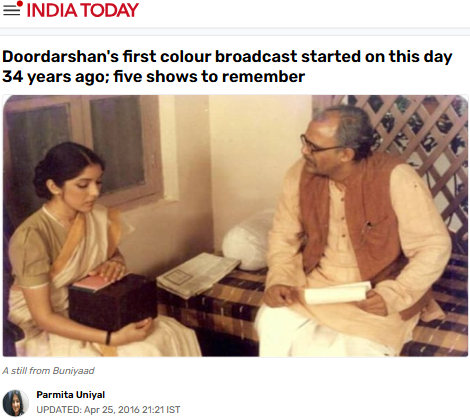
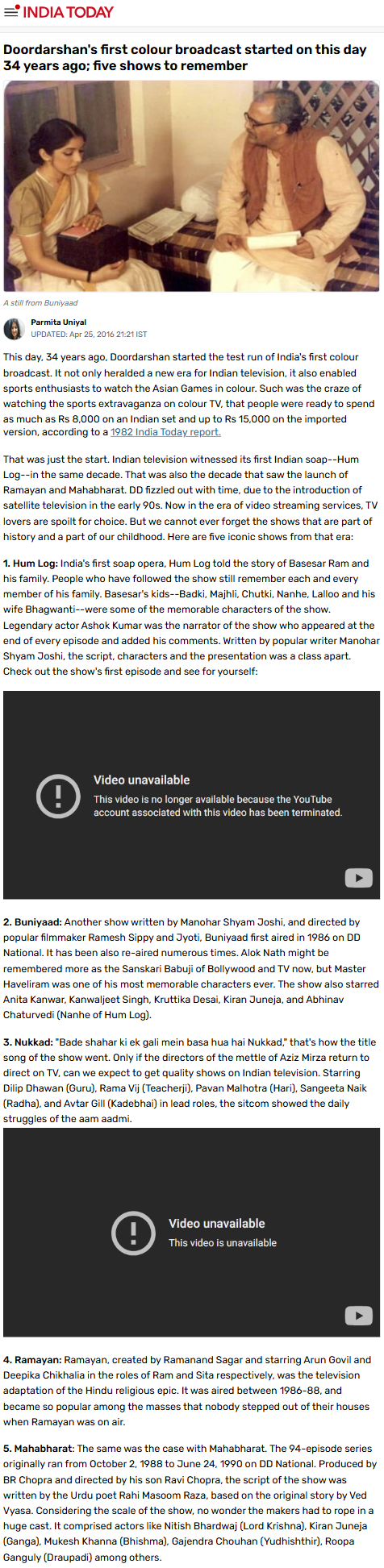
1069. Doordarshan's first colour broadcast started on this day 34 years ago; five shows to remember
- On August 15, 1982, India launched colour TV transmissions nationwide, coinciding with the 1982 Asian Games to showcase the event in colour to homes across the country.
- Doordarshan started the test run of India’s first colour broadcast, marking the beginning of colour television in India and setting the stage for enhanced viewing experiences during major events like the 1982 Asian Games.
- The Indian government facilitated the launch by introducing a gift scheme for imported colour TVs and allowing select companies to manufacture domestic colour TV sets, enabling widespread access for viewers.
- The initiative aimed to enhance the viewing experience of the Asian Games, increase public adoption of colour TV technology, and mark the beginning of a new era in Indian television broadcasting.
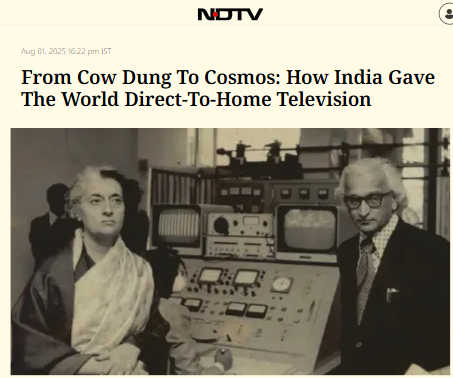
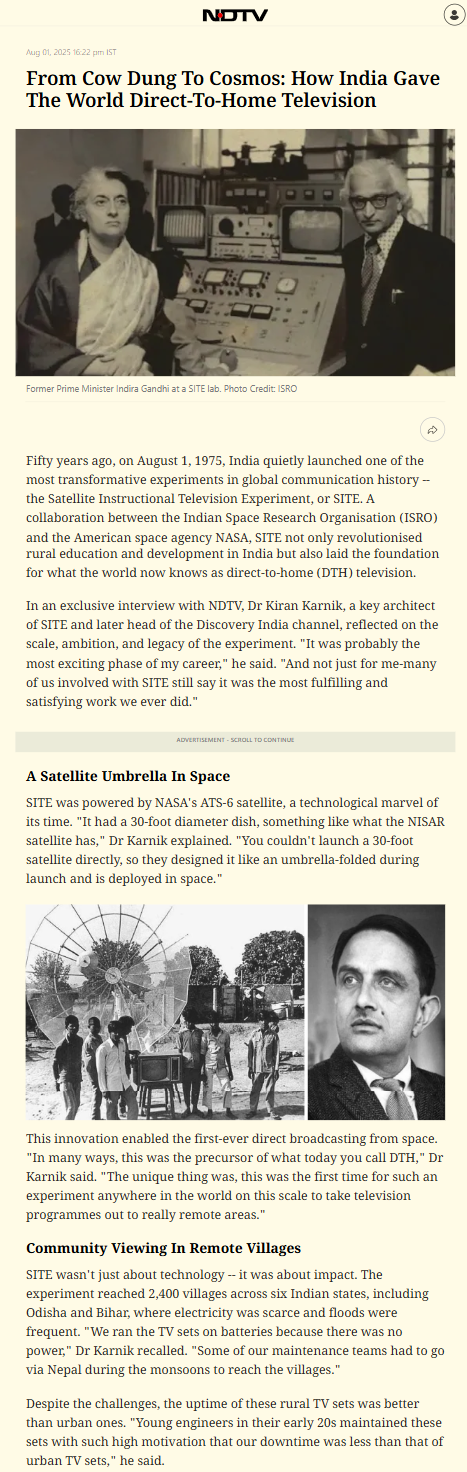
1070. From Cow Dung To Cosmos: How India Gave The World Direct-To-Home Television
- On August 1, 1975, India launched the Satellite Instructional Television Experiment (SITE) across 2,400 villages in six states, using NASA’s ATS-6 satellite to transmit educational and development-oriented programs to rural areas.
- Conducted by ISRO in collaboration with NASA, SITE utilized battery-powered TVs and locally developed ground equipment, with engineers and educators delivering area-specific content on agriculture, science, and education directly to remote communities.
- In 1975, Doordarshan launched the Satellite Instructional Television Experiment (SITE) to deliver educational content to rural areas across six Indian states, bringing lessons directly to villages for the first time.
- SITE revolutionized rural communication, trained 50,000 science teachers, inspired DTH television, and established ISRO’s ethos of applying technology for social development, leaving a lasting legacy in India’s broadcasting and educational landscape.