 Loading...
| Jan 01, 1970 | Daily Report |
| RISING BHARAT | News Count (102191) | |


1081. Odisha Signs Rs 46,200 Cr Maritime Pacts In Gujarat For Shipbuilding Cluster, Bahuda Port
Infrastructural Development and Government Schemes
->
Infrastructure
English
Gujarat
(Bhavnagar)
SWARAJYA
|
- On September 19, 2025, the Odisha government signed two MoUs at Bhavnagar, Gujarat, worth ₹46,200 crore to develop a shipbuilding cluster in Kendrapada and a satellite port project at Bahuda in Ganjam district.
- Odisha Maritime Board, Paradip Port Authority, and Sagarmala Finance Corporation will jointly develop land-side and river-side infrastructure, aiming to establish integrated shipbuilding and port facilities through large shipyards, ancillary industries, and financing support for sustainable maritime growth.
- The Kendrapada cluster will cost ₹24,700 crore, span 2,000–2,500 acres, and target 1–1.2 million GT annually with 2–2.5 km waterfront. The Bahuda port project, worth ₹21,500 crore, will enhance competitiveness, attract investments, and expand India’s shipbuilding capacity.
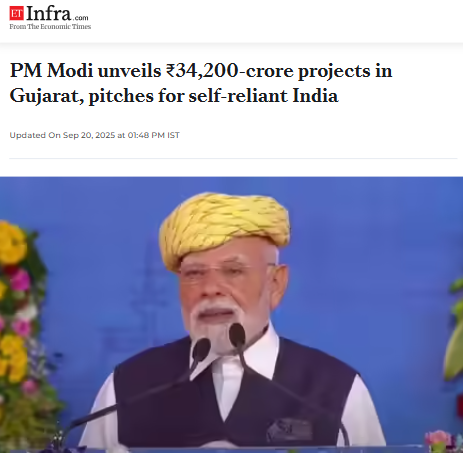

1082. PM Modi unveils ₹34,200-crore projects in Gujarat, pitches for self-reliant India
Infrastructural Development and Government Schemes
->
Infrastructure
English
Gujarat
(Bhavnagar)
Economic Times
|
- On September 20, 2025, Prime Minister of India inaugurated and laid foundation stones for projects worth ₹34,200 crore during the Samudra Se Samriddhi programme at Jawahar Maidan, Bhavnagar, with a major focus on the maritime sector.
- PM , addressing a large gathering, highlighted Atmanirbhar Bharat, cruise tourism, and service initiatives like Sewa Pakhwada. He launched port modernisation, inland waterways, and international cruise terminal projects to strengthen India’s maritime and economic growth.
- Key developments include ₹26,354 crore projects in Gujarat, such as HPLNG Regasification Terminal, PM-KUSUM solar feeder, Dhordo solar village, hospital expansions, roadways, and Dholera Special Investment Region. Maritime projects span Mumbai, Kolkata, Paradip, Ennore, Chennai, Car Nicobar, Patna, and Varanasi.
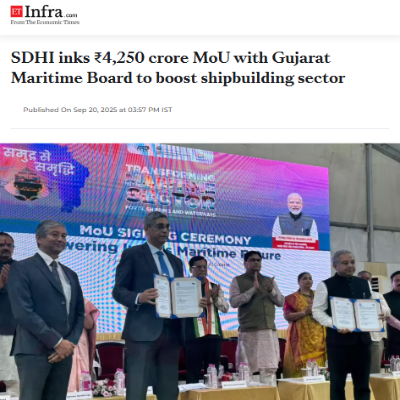

1083. SDHI inks ₹4,250 crore MoU with Gujarat Maritime Board to boost shipbuilding sector
Make in India / Atmanirbhar
->
‘Make in India – Defence Sector
English
Gujarat
(Amreli)
Economic Times
|
- On September 20, 2025, Swan Defence and Heavy Industries Limited (SDHI) signed an MoU with Gujarat Maritime Board to invest ₹4,250 crore in shipbuilding projects at its Pipavav Port shipyard, Gujarat.
- Rear Admiral Vipin Kumar Saxena (retd.), CEO of SDHI, announced collaborations with GMB and Sagarmala Finance Corporation to expand shipyard capacity, develop skills, and support maritime infrastructure through investments, training, and technology adoption.
- Investment includes ₹3,500 crore for shipyard expansion, ₹200 crore for a Maritime Centre of Excellence training 1,000 youth annually, and ₹550 crore for a 200-acre Maritime Cluster. Projects align with Maritime India Vision 2030 and Amrit Kaal Vision 2047.
1084. Doordarshan Launches New Channel ‘DD Retro’ To Telecast All Classic Hit Shows As Its Viewership Tops Charts
Life for Society: Case Studies
->
Inspiring Stories of Students/Employees/Senior citizen/Organisation/individual
English
India
SWARAJYA
|
- On Apr 12, 2020 Prasar Bharti launched DD Retro, a channel dedicated to old classic Doordarshan shows, following the successful re-telecast of Ramayana and Mahabharat, aiming to reach viewers across India.
- State-owned broadcaster Prasar Bharti announced DD Retro via Twitter, leveraging nostalgia and high viewership of epic re-telecasts, with mandatory carriage on all DTH and cable networks as per government decree.
- Viewership of Ramayana at 9 AM and 9 PM grew 60 times, while Mahabharat at 12 PM and 7 PM surged 208 times, making Doordarshan India’s most-watched channel in Hindi markets, demonstrating strong audience demand for classic content.
1085. Throwback Thursday: Ramanand Sagar's Ramayan is the most expensive mythological show of its time
Life for Society: Case Studies
->
Inspiring Stories of Students/Employees/Senior citizen/Organisation/individual
English
India
India Today
|
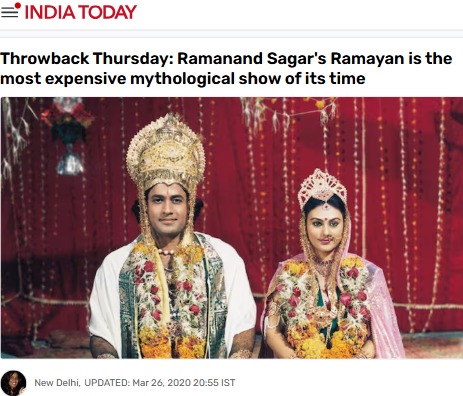
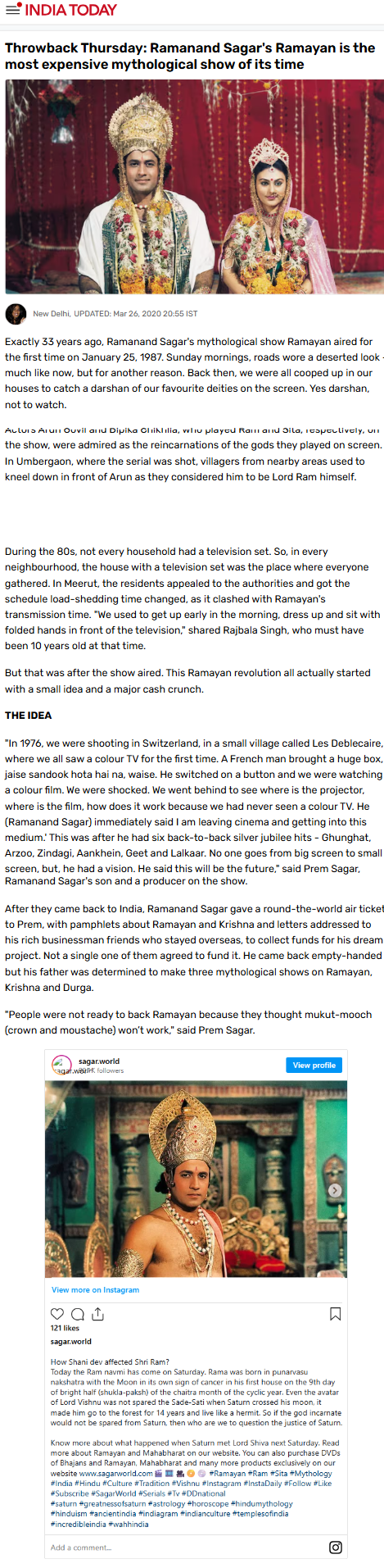
- On January 25, 1987, Ramanand Sagar’s mythological TV show Ramayan premiered on Doordarshan, capturing nationwide attention as viewers across India gathered in homes and neighborhoods to watch the epic unfold.
- Ramanand Sagar, inspired by a colour TV in Switzerland, and his son Prem Sagar produced Ramayan, securing funds through sponsors after their prior success with Vikram Aur Betaal, creatively adapting the epic for 1980s Indian audiences.
- The show’s tweaks, like Ram’s gurukul days and Bharat refusing the crown, resonated widely. First telecast viewership reached 40 million, generating Rs 23 crore revenue, later broadcast in 53 countries, and ultimately viewed by over 650 million globally.
1086. Doordarshan's first colour broadcast started on this day 34 years ago; five shows to remember
Life for Society: Case Studies
->
Inspiring Stories of Students/Employees/Senior citizen/Organisation/individual
English
India
India Today
|
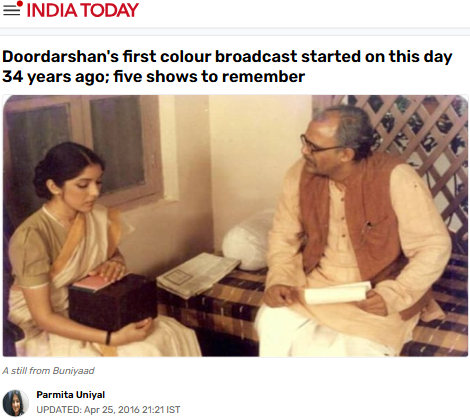
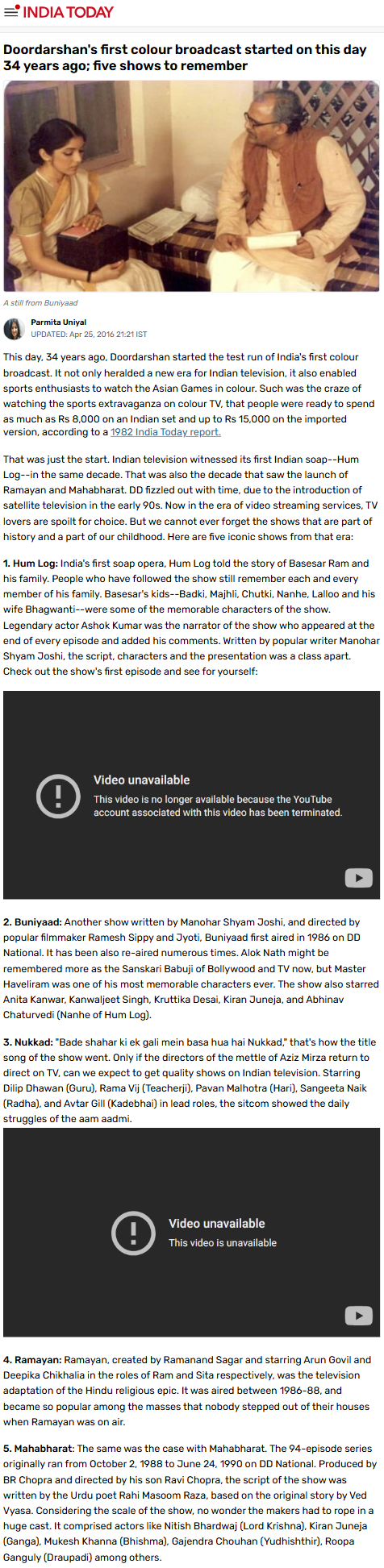
- On August 15, 1982, India launched colour TV transmissions nationwide, coinciding with the 1982 Asian Games to showcase the event in colour to homes across the country.
- Doordarshan started the test run of India’s first colour broadcast, marking the beginning of colour television in India and setting the stage for enhanced viewing experiences during major events like the 1982 Asian Games.
- The Indian government facilitated the launch by introducing a gift scheme for imported colour TVs and allowing select companies to manufacture domestic colour TV sets, enabling widespread access for viewers.
- The initiative aimed to enhance the viewing experience of the Asian Games, increase public adoption of colour TV technology, and mark the beginning of a new era in Indian television broadcasting.
1087. From Cow Dung To Cosmos: How India Gave The World Direct-To-Home Television
Life for Society: Case Studies
->
Inspiring Stories of Students/Employees/Senior citizen/Organisation/individual
English
India
NDTV
|
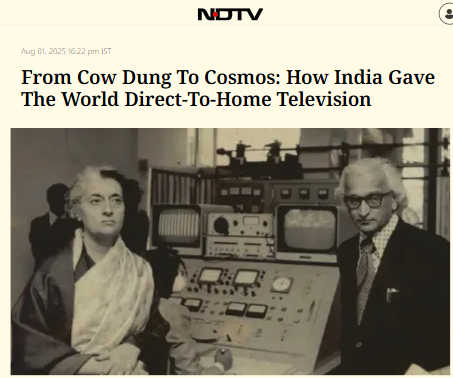
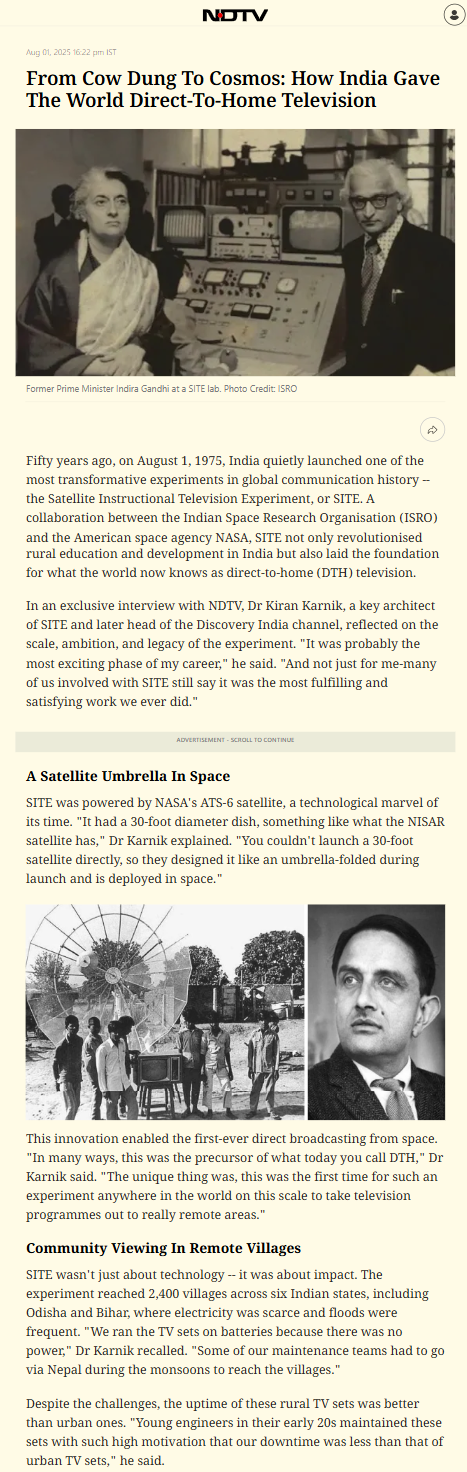
- On August 1, 1975, India launched the Satellite Instructional Television Experiment (SITE) across 2,400 villages in six states, using NASA’s ATS-6 satellite to transmit educational and development-oriented programs to rural areas.
- Conducted by ISRO in collaboration with NASA, SITE utilized battery-powered TVs and locally developed ground equipment, with engineers and educators delivering area-specific content on agriculture, science, and education directly to remote communities.
- In 1975, Doordarshan launched the Satellite Instructional Television Experiment (SITE) to deliver educational content to rural areas across six Indian states, bringing lessons directly to villages for the first time.
- SITE revolutionized rural communication, trained 50,000 science teachers, inspired DTH television, and established ISRO’s ethos of applying technology for social development, leaving a lasting legacy in India’s broadcasting and educational landscape.
1088. Doordarshan turns 60, people become nostalgic
Life for Society: Case Studies
->
Inspiring Stories of Students/Employees/Senior citizen/Organisation/individual
English
Delhi
(New Delhi)
Tribune India
|
- On September 15, 2019, it celebrated its 60th anniversary, marking six decades of broadcasting. By 1972, Doordarshan expanded television services to Mumbai and Amritsar, and by 1975, to seven more Indian cities.
- Initially part of All India Radio, Doordarshan operated under AIR’s administration, delivering public service television to multiple cities across India.
- On April 1, 1976, it became a separate department under the Ministry of Information and Broadcasting, transitioning into an independent television broadcaster and laying the foundation for its nationwide growth and legacy.

1089. 65 Glorious Years: Doordarshan’s Legacy in Shaping India’s Broadcasting History
Life for Society: Case Studies
->
Inspiring Stories of Students/Employees/Senior citizen/Organisation/individual
English
Delhi
(New Delhi)
DD News
|
- On 16 September, 2024 It was reported that, Doordarshan, India’s public service broadcaster, began on September 15, 1959, in Delhi. Initially experimental, it became a regular service in 1965, later separating from AIR in 1976 and expanding nationwide with satellite channels and DTH services. In 1995, Doordarshan launched DD India, its first international channel.
- Designed by NID alumnus Devashis Bhattacharyya with signature tune by Ravi Shankar, Doordarshan operates under Prasar Bharati. It leverages studios, transmitters, DTH, online platforms, and AI anchors to deliver content to metropolitan, regional, and international audiences.
- In 1961, Doordarshan launched school television programs for students in Delhi. These broadcasts focused on classroom lessons and educational content, becoming one of the earliest efforts to use television as a tool for learning in India.
- Iconic shows like Ramayana, Mahabharat, Hum Log, and Krishi Darshan set cultural benchmarks. DD supported education during COVID, launched DD Free Dish (45 million homes), HD sports, OTT presence, and continues innovative programming for entertainment, spiritual, and regional audiences.
1090. Nostalgia darshan: Doordarshan turns 58 making us look back at Krishi Darshan, Hum Log, Fauji
Life for Society: Case Studies
->
Inspiring Stories of Students/Employees/Senior citizen/Organisation/individual
English
Delhi
(New Delhi)
India Today
|
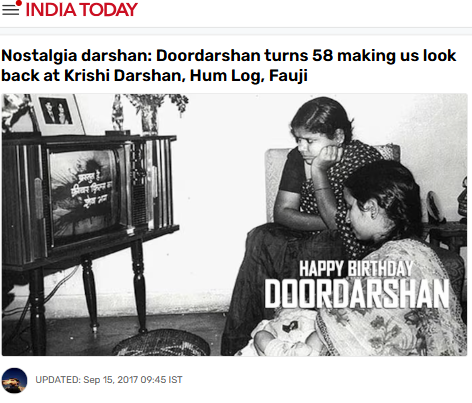
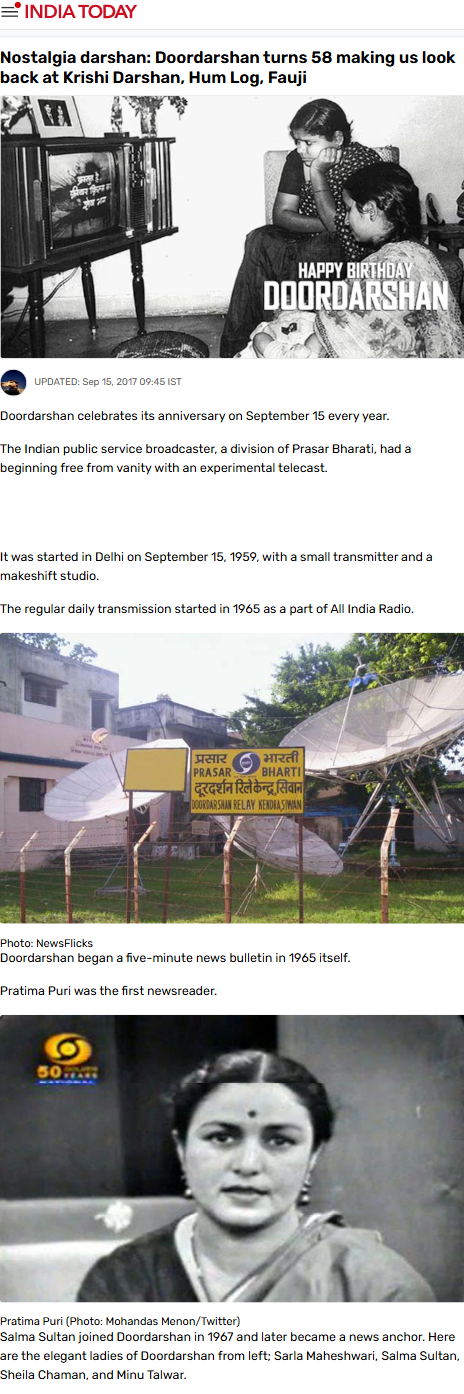
- On 15 september, 2017 It was reported that, Doordarshan, India’s public service broadcaster, began on September 15, 1959 in Delhi with an experimental telecast. Regular transmission and news bulletins started in 1965, and it celebrates its anniversary every year on September 15.
- Designed by NID student Devashis Bhattacharyya and set to Ravi Shankar’s sitar tune, DD’s logo and signature montage debuted in 1976 when TV services separated from AIR, marking a new era for Indian broadcasting.
- From Krishi Darshan (1967) to iconic serials like Hum Log, Buniyaad, Nukkad, Mahabharata and Chitrahaar, DD shaped Indian television’s golden era in the ’80s, reaching millions of homes and remaining a cultural touchstone despite private channel competition.