 Loading...
| Jan 01, 1970 | Daily Report |
| RISING BHARAT | News Count (102991) | |
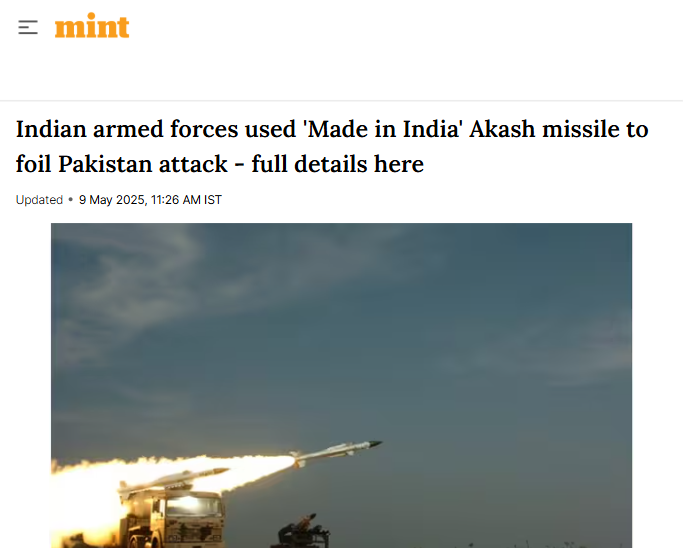
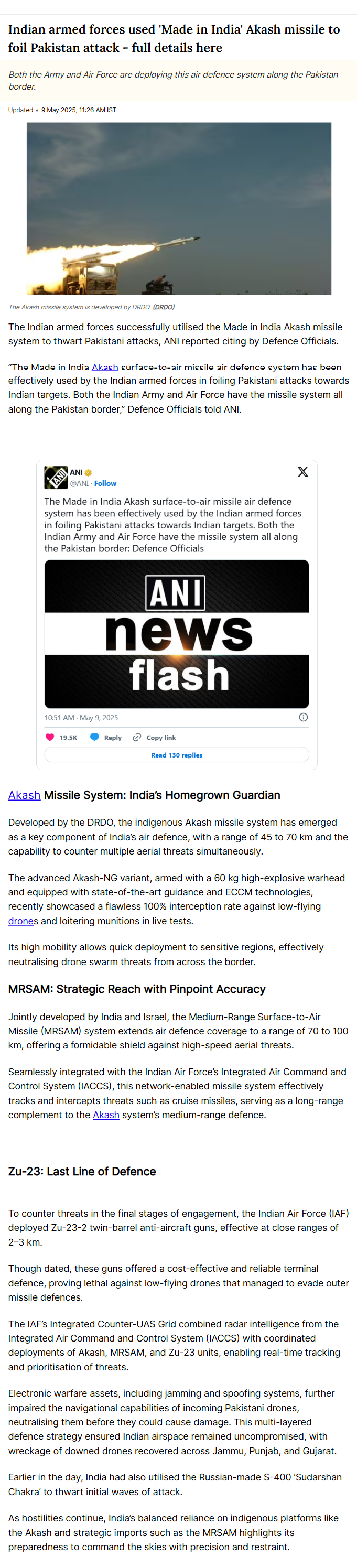
1941. Indian armed forces used 'Made in India' Akash missile
- The Akash Missile System is a medium-range mobile surface-to-air missile system developed indigenously. It has multiple variants, including Mk-I, 1S, Prime, and NG, with ranges varying from 25 to 80 km and speeds of Mach 2.5 to 4.5
- The Akash-NG variant, with a range of 70-80 km, entered service in 2024.
- The long-delayed but finally successful induction of the Akash systems in 2014, developed by DRDO and manufactured by defence PSU Bharat Dynamics
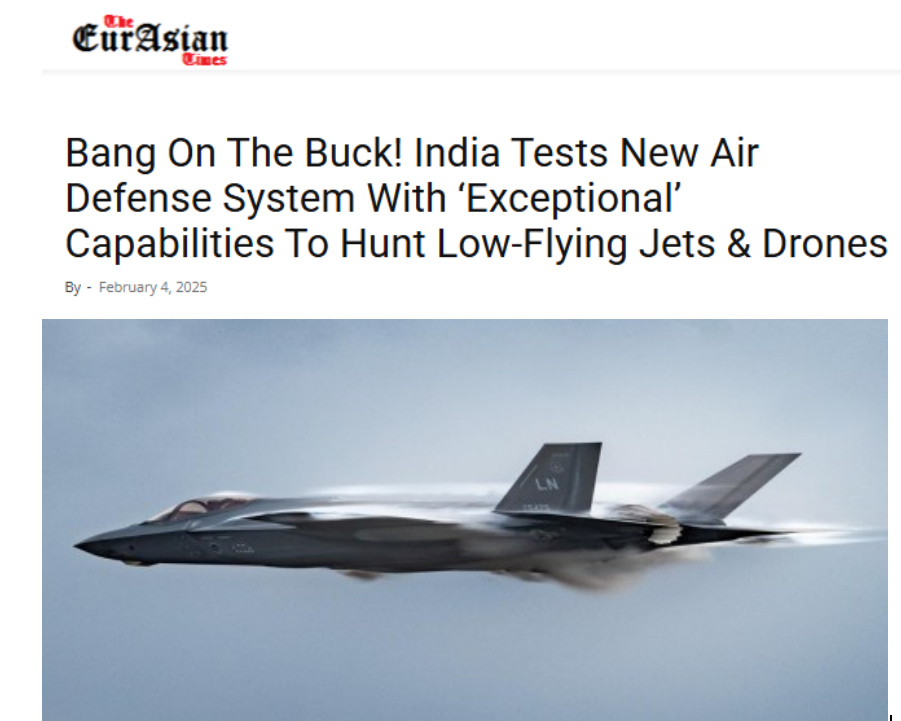

1942. India Tests New Air Defense System With ‘Exceptional’ Capabilities To Hunt Low-Flying Jets & Drones
- The DRDO-developed Very Short Range Air Defence System (VSHORADS) is optimized to counter low-altitude aerial threats.
- The VSHORADS has involved the Indian Army, Navy, and Air Force from the outset, with all three services participating in its developmental trials.
- The missile measures 2 meters in length, 0.09 meters in diameter, and weighs 21 kg. It can engage targets at ranges of 6–7 km and achieve a top speed of Mach 1.5. While its speed and range are less than those of the Russian Igla-S or the US Stinger missiles.
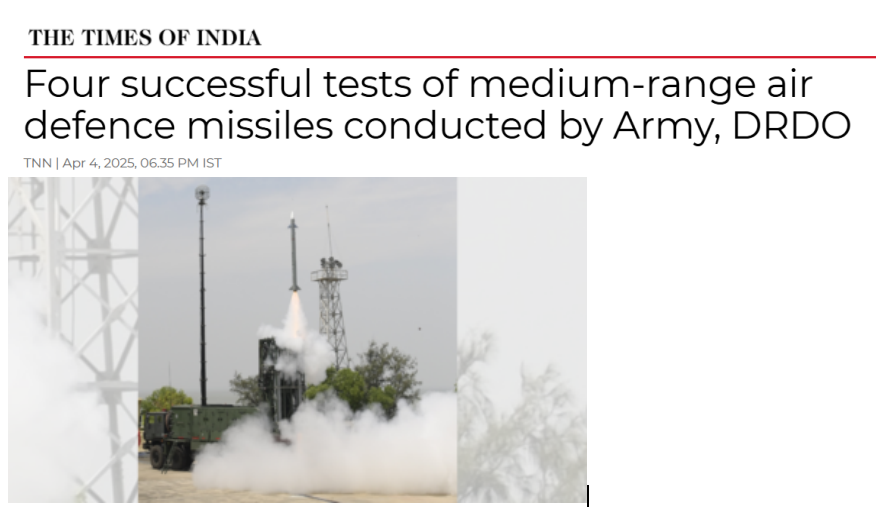
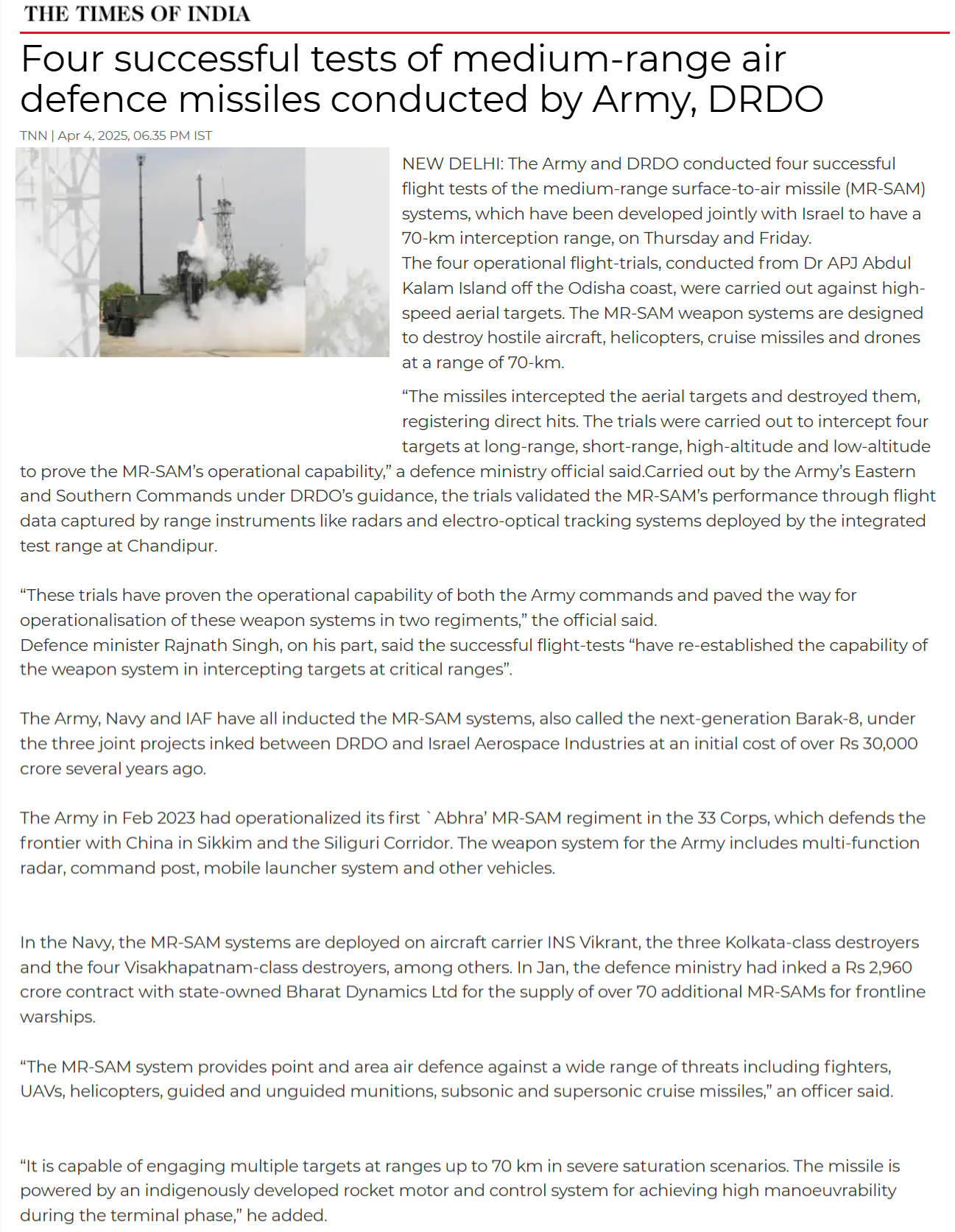
1943. Four successful tests of medium-range air defence missiles
- The Army and DRDO conducted four successful flight tests of the medium-range surface-to-air missile (MR- SAM) systems, which have been developed jointly with Israel.
- The Army in Feb 2023 had operationalized its first Abhra’ MR-SAM regiment in the 33 Corps, which defends the frontier with China in Sikkim and the Siliguri Corridor.
- The MR-SAM weapon systems are designed to destroy hostile aircraft, helicopters, cruise missiles and drones at a range of 70-km.
1944. Quick Reaction Surface-to-Air Missile successfully test fired
- The Quick Reaction Surface-to-Air Missile (QRSAM) is an area defense system designed for search-on-move, track- on-move, and fire-on-short-halt operations, engaging multiple targets up to 30 km.
- Designed to be a quick reaction missile, it involves an all- weather weapon system capable of tracking and firing.
- The operates with a two-vehicle configuration: a fully automated Command and Control System, an Active Array Battery Surveillance Radar (BSR), an Active Array Battery Multifunction Radar (BMFR), and a Launcher.


1945. Indian Air Force (IAF) SPYDER
- The SPYDER is a low-level, quick-reaction surface-to- air missile system capable of engaging aircraft, helicopters, unmanned air vehicles, drones, and precision- guided munitions.
- There are two variants of the SPYDER: the SPYDER-SR (short range) and the SPYDER-MR (medium range). Both systems are quick reaction, all weather, network-centric, multi-launchers, and self-propelled.
- The full form of SPYDER is Surface to air Python and Derby. It is a short and medium-range mobile air defence system from Israel that has been developed by Rafael (Rafael Advanced Defence Systems) and IAI (Israeli Aerospace Industries).
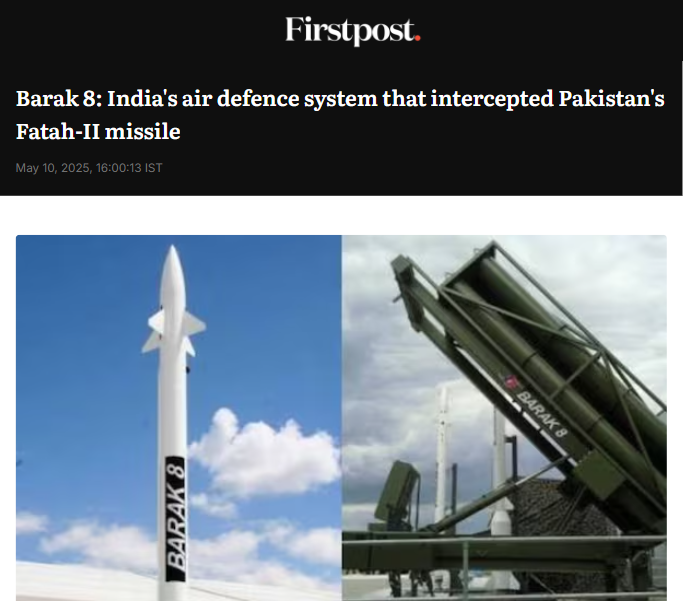

1946. Barak 8 India's air defence system
- Barak 8 is designed and developed by the Defence Research and Development Organisation (DRDO) and Israel Aerospace Industries (IAI).
- MRSAM has mobile launchers that can be deployed on land or on navy vessels Weighing 275 kg, the missile can carry a 60-kg warhead.
- With a speed up to Mach 2, the missile boasts a dual pulse rocket motor and thrust vector control (TVC ) . The state-of-the-art weapon is equipped with digital radar, interceptors with modern RF sensors, two-way data link and system-wide connectivity
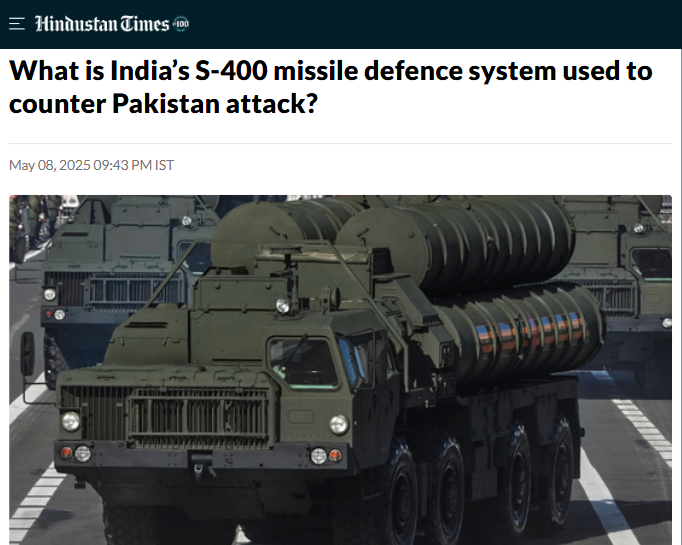
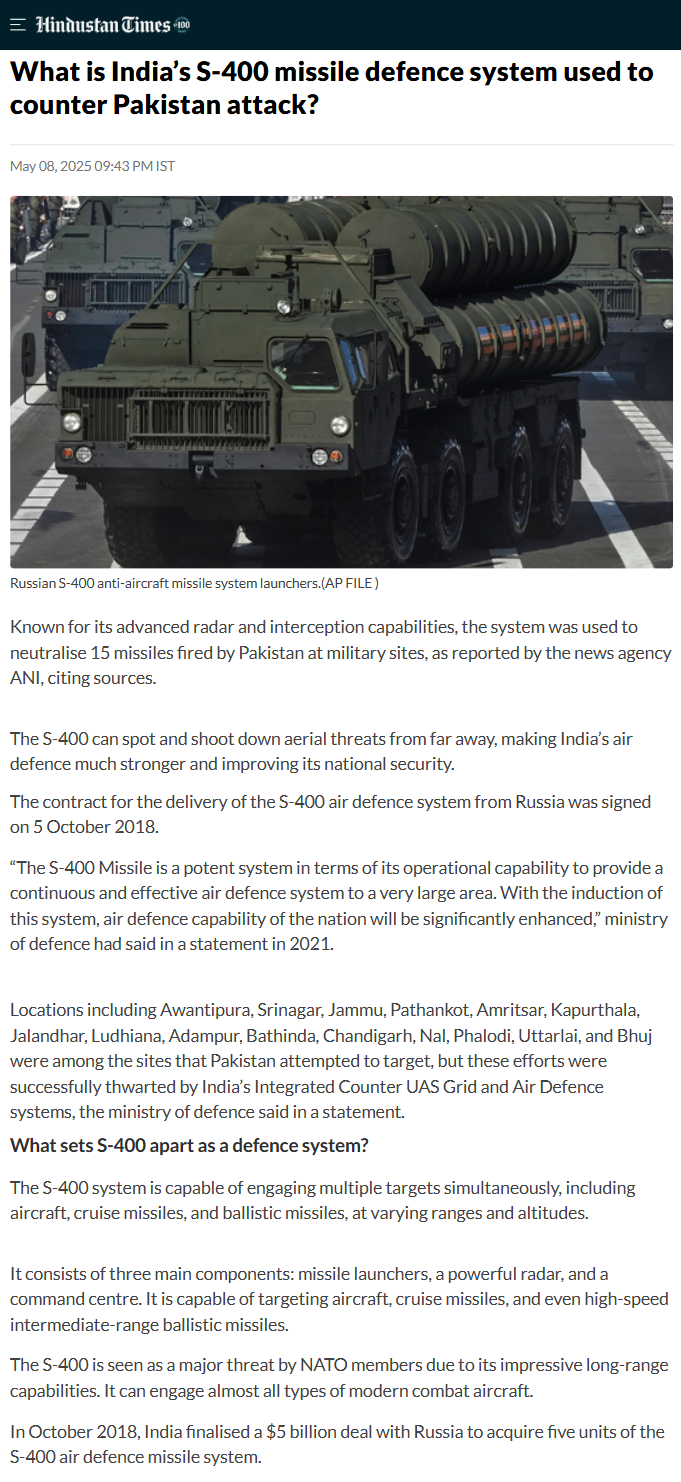
1947. India’s S-400 missile defence system used to counter Pakistan attack
- The S-400 Triumf is a Russian-made mobile long-range surface-to-air missile system that India began acquiring under a deal signed in 2018 for five squadrons. As of 2023, three squadrons have been deployed
- The S-400 system is capable of engaging multiple targets simultaneously, including aircraft, cruise missiles, and ballistic missiles, at varying ranges and altitudes.
- The S-400 is seen as a major threat by NATO members due to its impressive long-range capabilities. It can engage almost all types of modern combat aircraft.
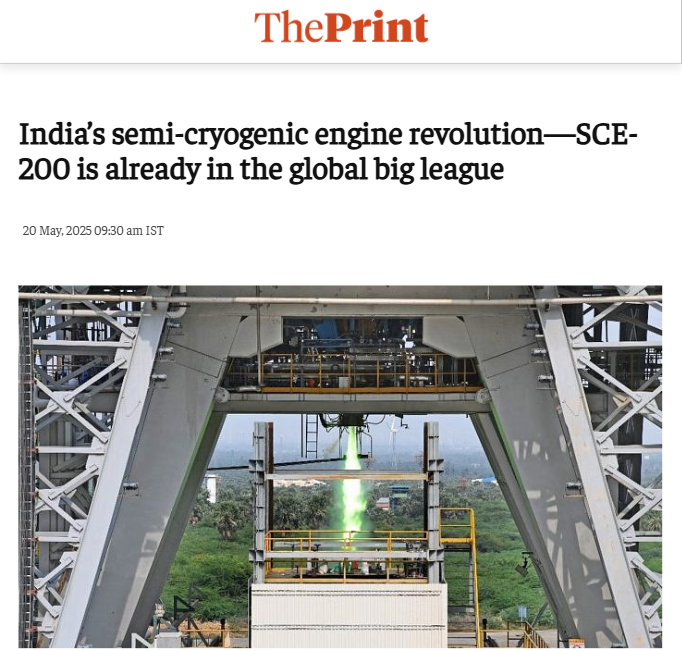
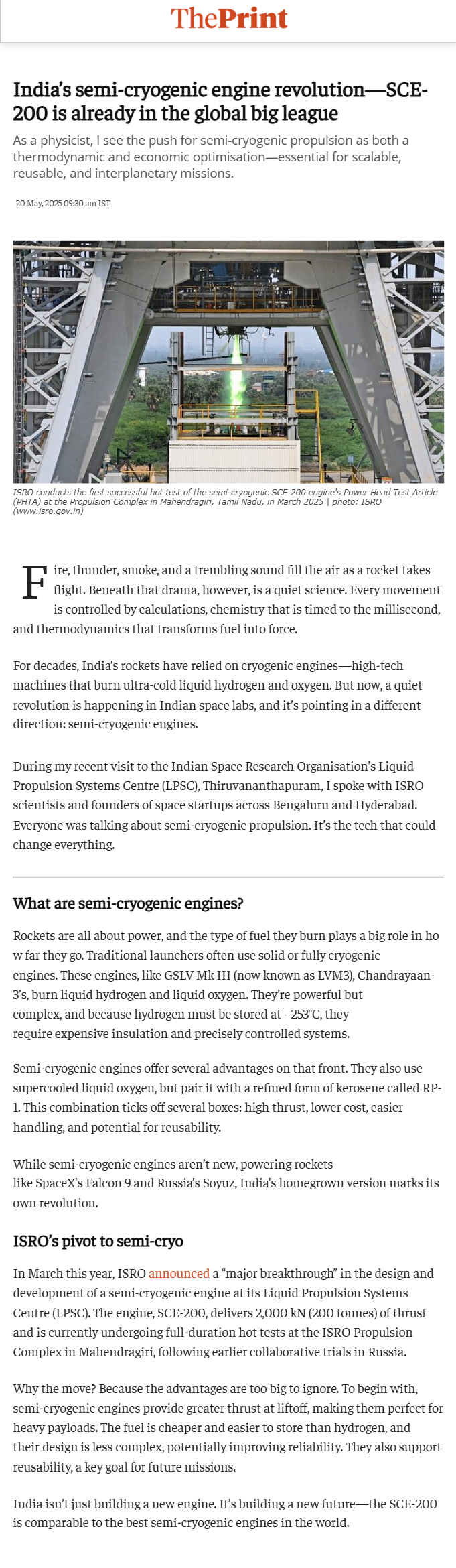
1948. India’s semi-cryogenic engine revolution—SCE-200 is already in the global big league
- On 20 May 2025, . India’s rockets have relied on cryogenic engines—high-tech machines that burn ultra-cold liquid hydrogen and oxygen.
- Indian Space Research Organisation’s Liquid Propulsion Systems Centre (LPSC), Thiruvananthapuram, I spoke with ISRO scientists and founders of space startups across Bengaluru and Hyderabad.
- The combination ticks off several boxes: high thrust, lower cost, easier handling, and potential for reusability.
Click here to find 462 similar incidents of Make in India / Atmanirbhar -> Space


1949. Assam Government Signs Investment Agreements worth Rs. 22,900 Crore
- On May 19, 2025, the Assam Government signed investment agreements worth Rs 22,900 crore for 20 major projects across diverse sectors during a ceremony at Srimanta Sankardev Kalakshetra.
- Stemming from the Advantage Assam 2.0 Summit, these include infrastructure projects like the Rs 7,800 crore Narengi-Kurua bridge and Rs 23,000 crore Guwahati-Silchar Expressway, alongside Rs 1,800 crore paper mills in Goalpara and a Rs 137 crore plastic recycling plant in Changsari.
- Green energy and dairy sectors see significant investments, with Rs 1,000 crore for 200 MW solar projects, a 250 MW battery storage system, and Amul’s Rs 75 crore dairy expansion targeting 10 lakh litres daily, creating 20,000 jobs.
- Supporting innovation, a new Department of Startup and Innovation aids 24 startups with Rs 2 crore, while a land bank and digital clearance system facilitate industrial growth, with more MoUs expected at a September–October investment event.
Click here to find 90 similar incidents of North East India -> Industrial Development
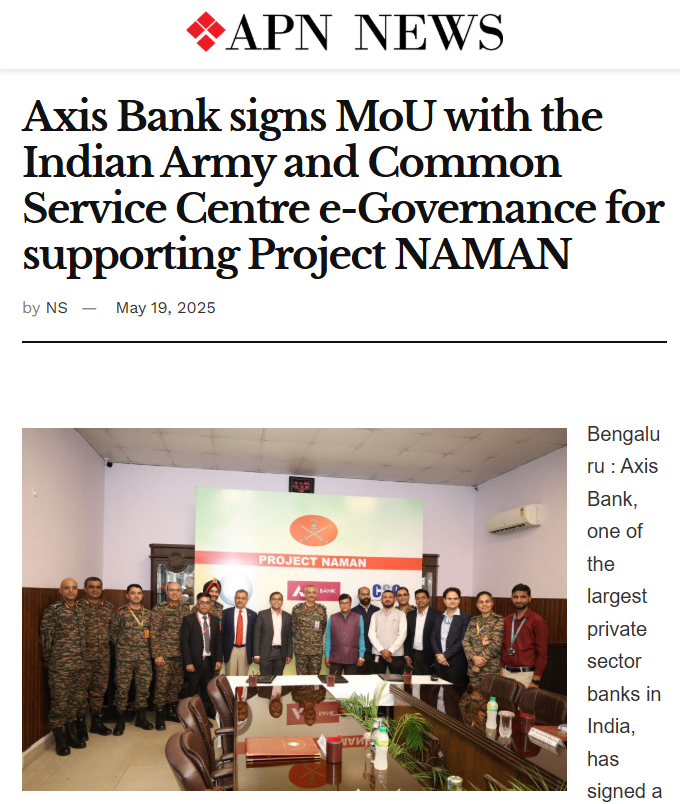
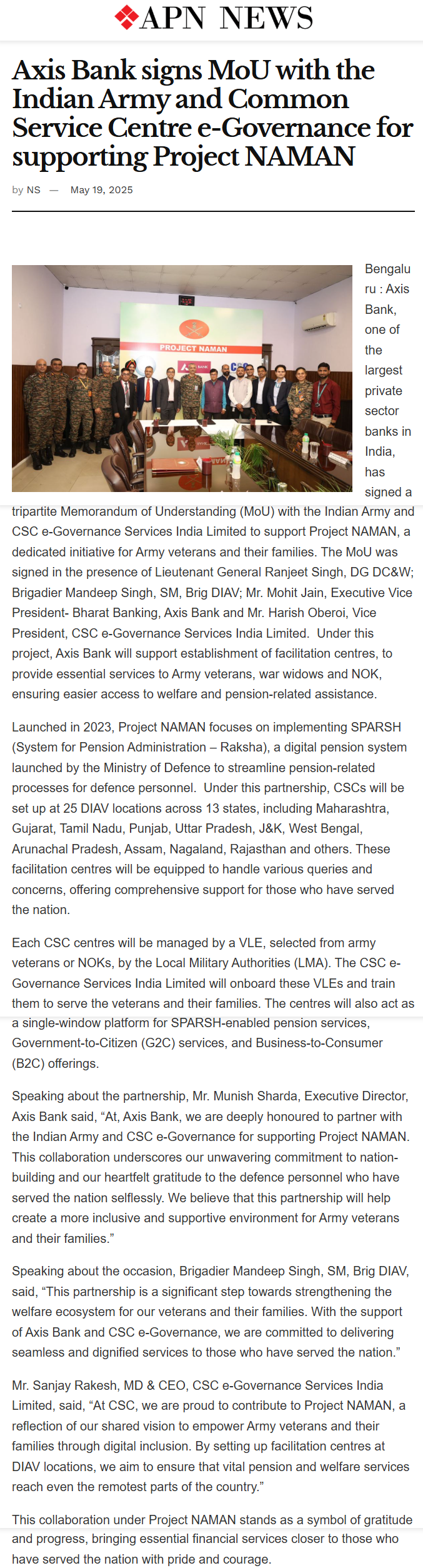
1950. Axis Bank signs MoU with the Indian Army and Common Service Centre e-Governance for supporting Project NAMAN
- On 19 may 2025 It was reported that, Bengaluru : Axis Bank, one of the largest private sector banks in India, has signed a tripartite Memorandum of Understanding (MoU) with the Indian Army and CSC e-Governance Services India Limited to support Project NAMAN, a dedicated initiative for Army veterans and their families.
- Under this project, Axis Bank will support establishment of facilitation centres, to provide essential services to Army veterans, war widows and NOK, ensuring easier access to welfare and pension-related assistance.
- This collaboration under Project NAMAN stands as a symbol of gratitude and progress, bringing essential financial services closer to those who have served the nation with pride and courage.